A coin scanner identifies a coin from a photo and tells you what it's worth: face value, metal value and any collector premium. Snap both sides, confirm the date and mint mark, and How Much Is It Worth: Scanner checks current listings plus Numista catalogue data for that exact coin. It's a free coin identifier and value check in the iPhone app, and you can try one coin here online with no download.
Best on iPhone
Start your free 3-day trial. 3 free scans + 3-day unlimited trial in How Much Is It Worth: Scanner. Got a whole box to get through? The trial gives you unlimited scans, and after your free scans you still get 1 free scan every week.
The 3-day free trial comes with the Yearly plan, and the app shows every plan before you start. Cancel in your App Store settings at least 24 hours before the trial ends and you won't be charged.
Not on iPhone yet? Try one free web scan right here, no download needed. On Android? Check https://howmuchisitworth.today/ for the Android release.
No download needed: snap or upload a photo below for one free web scan a day. The app gives you 3 free scans, then 1 free every week, saves your history and drafts listings for you.
Real scan · prices checked 10 Nov 2026
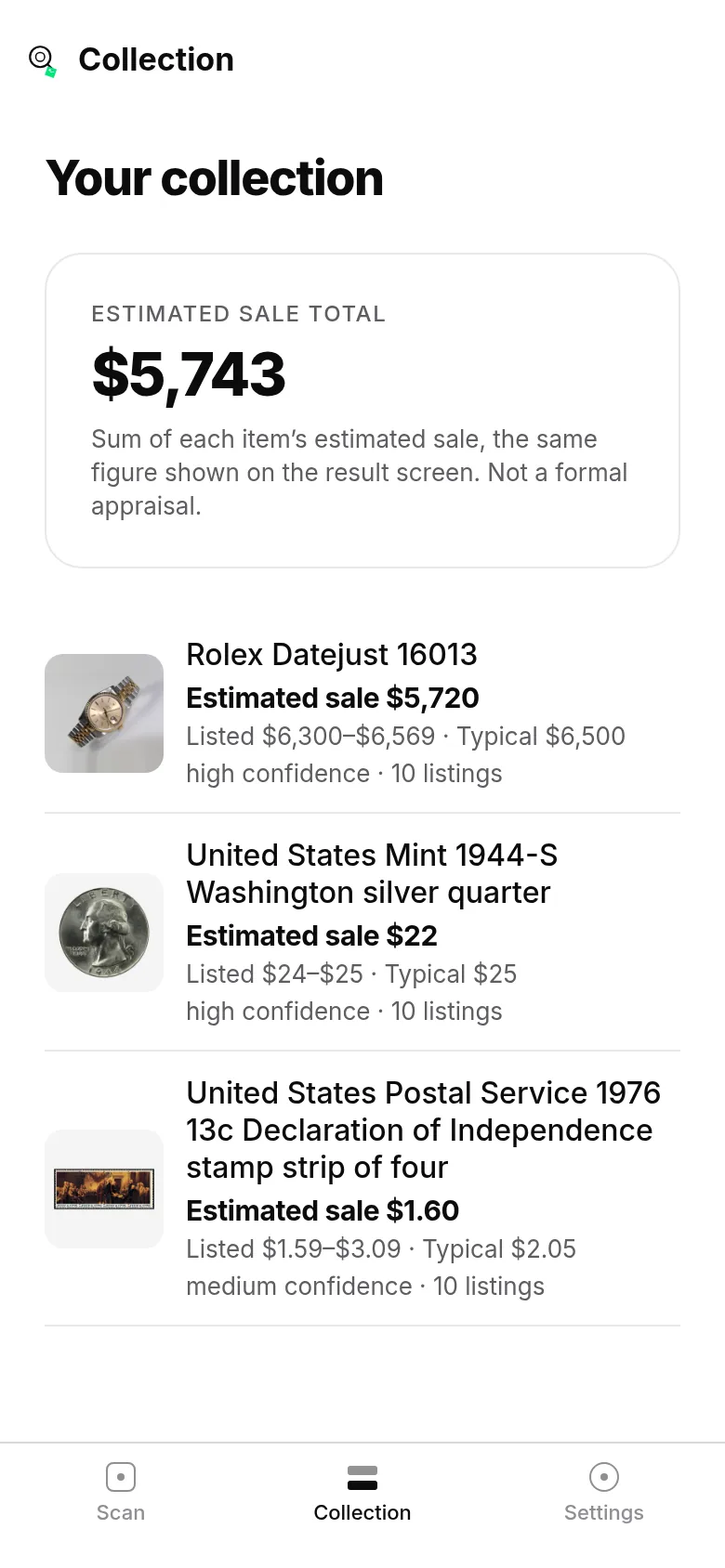
A saved collection with a 1944-S silver quarter
1944-S quarter: listed $24 to $25 · estimated sale $22 · high confidence, 10 listings
Our own collection screen. Each scan keeps its estimated sale, and the total adds them up. Silver quarters like this one have a melt floor, so they rarely sell far below it. In-app example from How Much Is It Worth. Screenshot is our own work. The watch photograph inside it is credited on the credits page. See also photo credits.
The three numbers every coin has
Most of the confusion about coin values comes from mixing up three different numbers. Get these straight and you'll stop overpaying and underselling.
| Number | What it means | When it matters |
|---|---|---|
| Face value | What it's legally worth as money | Almost all modern circulating coins. A worn 1990s quarter is a quarter. |
| Melt value | What the metal inside is worth at today's price | US dimes, quarters and halves dated 1964 and earlier, war nickels, silver dollars, gold |
| Collector value | What collectors pay for that date, mint, grade or error | Key dates, low mintages, high grades, errors and varieties |
A good coin value checker tells you which of the three you're dealing with before it gives you a number. That's what the scanner does first.
Silver melt values for common US coins
These come from NGC's coin melt value table, updated 10 November 2026. Melt moves with the silver price every day, so treat these as a dated snapshot, not a quote. They're the floor. A dealer buying junk silver will usually pay a bit under melt, and a collector may pay well over it for a nice date.
| Coin | Silver | Melt (NGC, 10 Nov 2026) | Guide |
|---|---|---|---|
| Dime, 1964 and earlier | 90% (0.0723 oz) | $3.73 | Dime values |
| Quarter, 1964 and earlier | 90% (0.1808 oz) | $9.33 | Quarter values |
| War nickel, 1942 to 1945 | 35% | $2.91 | Nickel values |
| Kennedy half, 1964 | 90% (0.36169 oz) | $18.67 | 1964 Kennedy half |
| Kennedy half, 1965 to 1970 | 40% | $7.63 | Kennedy half dollar value |
| Morgan or Peace dollar | 90% (0.7734 oz) | $39.92 | Morgan dollars, Peace dollars |
Source: NGC Coin Melt Values, updated 10 November 2026, silver ask $51.62 per troy ounce.
Where to find the mint mark
The mint mark is the letter that tells you where a coin was struck: P for Philadelphia, D for Denver, S for San Francisco, W for West Point, and on older coins CC for Carson City and O for New Orleans. Many key dates are only valuable with one particular mark, so this is the detail people get wrong most. Here's where to look on the coins that turn up most:
| Coin | Where the mint mark is |
|---|---|
| Lincoln cent | Front, under the date (no mark usually means Philadelphia) |
| Jefferson nickel | Back, right of Monticello (1938 to 1964); big mark above the dome on 1942 to 1945 war nickels; front, under the date from 1968 |
| Roosevelt dime | Back, left of the torch (1946 to 1964); front, above the date from 1968 |
| Washington quarter | Back, under the eagle (1932 to 1964); front, right of the ponytail from 1968 |
| Kennedy half | 1964: back, left of the eagle's tail; from 1968: front, above the date |
| Morgan dollar | Back, under the wreath, above the "DO" in DOLLAR |
The scanner reads the mark from your close-up. If it's worn and we can't read it, we'll tell you rather than guess a valuable one.
How the coin scanner works
- Photograph both sides. Then add a close-up of the date and mint mark as your third photo.
- Confirm the coin. Country, denomination, year, mint mark. Change anything that's wrong.
- We price it. Numista catalogue data for coins and banknotes, current public listings, and a live metal price as the floor for silver and gold.
- Set the condition and read the result: Worth about, listed range, estimated sale, confidence and the listings.
Real example from our testing, prices checked 10 November 2026: a 1944-S Washington silver quarter came back listed at $24 to $25 across 10 listings, with an estimated sale of $22 and high confidence. That's well over its $9.33 melt, because a nice 1940s S-mint quarter carries a small collector premium.
What affects a coin's value, beyond the date
- Grade. US coins are graded on a 1 to 70 scale. The jump from a worn coin to an uncirculated one can be huge on scarcer dates and almost nothing on common ones.
- Cleaning. Never clean a coin. Polishing, dipping or rubbing leaves hairlines that collectors spot instantly, and it can wipe out most of the premium.
- Errors and varieties. Doubled dies, off-centre strikes, repunched mint marks, wrong planchets. Our error coin guide covers the ones worth checking.
- Eye appeal and toning. Natural, even toning can add money. Blotchy or artificial toning takes it away.
- Altered coins. Added mint marks and changed dates are common on famous keys like the 1914-D cent and 1916-D dime. If you think you've found one, get it authenticated.
Pennies, nickels and the coins in your jar
Most coins from change are worth face. The ones to pull out: wheat cents (1909 to 1958), 1943 steel cents, 1964 and earlier dimes, quarters and halves, 1942 to 1945 war nickels, and anything with obvious doubling. Our guide to what pennies are worth money has a key-date table with sourced catalogue prices. For the rest, start at how much is my coin worth or browse the coin price guides.
World coins and banknotes
The scanner isn't just for US coins. Numista covers coins and notes from just about every country, so a UK, Australian or Canadian coin gets identified the same way. Banknotes work too: photograph both sides so the series, seal and serial are readable. See the $2 bill guide and silver certificate values for US paper.
Selling coins
Common silver goes to a coin shop or bullion dealer by weight. Better dates and graded coins usually do better listed online or with a specialist dealer. Pawn shops rarely pay collector money for coins, so check the pawn shop value estimator before you take that route. The app drafts listings for eBay, Facebook Marketplace or Gumtree straight from your scan.
3 free scans + 3-day unlimited trial
What makes How Much Is It Worth different
One photo is enough to start, and you can add up to two more angles. We identify the item first, you confirm or correct it, then we look up a Worth about figure and a listed range from current public marketplace listings. Those are asking prices, which can sit above what a piece finally sells for. You see the listings themselves when we find enough of them.
Coins and banknotes also draw on Numista. Trading cards use PokéWallet, with a source credit where that data appears. Gold and silver use a live metal price as a floor. If listings are thin, we show a clearly labelled rough estimate rather than inventing a precise number. The app can draft a listing for eBay, Facebook Marketplace, or Gumtree once you are ready to sell. For the short version of this process, read How we price.
Start your free 3-day trial
3 free scans + 3-day unlimited trial
| Option | What you get |
|---|---|
| Free in the app | 3 free scans to start, then 1 free scan every week |
| 3-day free trial | Unlimited scans, every listing behind the price, listing drafts and collections |
| Web scan on this site | One free scan a day per connection, no download |
The app shows every plan before your trial starts. There are no one-time credit packs. On Android? Check https://howmuchisitworth.today/ for the Android release.
FAQ
Is there a free coin identifier and value app?
Yes. How Much Is It Worth: Scanner is free on the App Store with 3 free scans and then 1 a week, and you can identify one coin a day on this page without downloading anything. Premium gives unlimited scans with a 3-day free trial on the Yearly plan.
How do I find out what my coin is worth?
Work out whether it's worth face, melt or a collector premium. That depends on the date, mint mark, metal and condition. Photograph both sides, confirm the identification, and the scanner checks Numista data, current listings and the metal price for you.
Can I check a coin's value by photo?
Yes. Two clear photos of the front and back, plus a close-up of the date and mint mark, are usually enough to identify it and price it.
Where is the mint mark on my coin?
It depends on the coin and year. On Lincoln cents it's under the date. On older dimes, quarters and nickels it's on the back; from 1968 it moved to the front. The table on this page lists the common ones.
Which US coins are worth more than face value?
Dimes, quarters and half dollars dated 1964 and earlier (90% silver), 1965 to 1970 Kennedy halves (40% silver), 1942 to 1945 war nickels, silver dollars, gold coins, key dates, errors and high-grade examples.
Should I clean my coins before scanning?
No. Cleaning leaves hairline scratches that collectors spot immediately, and it can wipe out most of a coin's collector premium. Photograph it exactly as it is.
Can the scanner read a graded coin in a slab?
Yes. Photograph the coin through the holder and make sure the label is readable. The grade on the label is part of what we price.
Does it work on world coins and banknotes?
Yes. Numista catalogues coins and notes from almost every country, so UK, Australian, Canadian and other coins are identified the same way. For banknotes, photograph both sides so the series and serial are readable.
How accurate is a coin value checker?
Identification is the hard part, which is why you confirm the date and mint mark before we price. The result shows a confidence level and the listings behind it. For a possible key date or error, get a professional opinion too.
What's the melt value of a silver quarter?
NGC's melt table, updated 10 November 2026, put a 1964 or earlier 90% silver quarter at $9.33. Melt moves with the silver price every day.
Do pawn shops pay full value for coins?
Usually not for collector coins. Most pay close to melt. A key date or graded coin often does better with a coin dealer or a listing.
Is there a coin scanner app for Android?
On Android? Check https://howmuchisitworth.today/ for the Android release. Your phone browser can run the web coin scan on this page once a day in the meantime.
Related coin guides
Sources
- NGC, Coin Melt Values, updated 10 November 2026. Silver ask $51.62 per troy ounce; melt figures for pre-1965 dimes ($3.73), quarters ($9.33), war nickels ($2.91), 1964 Kennedy halves ($18.67), 1965 to 1970 Kennedy halves ($7.63) and Morgan or Peace dollars ($39.92).
- How Much Is It Worth app results, prices checked 10 November 2026 (Australia/Melbourne): Rolex Datejust 16013 listed $6,300 to $6,569, typical $6,500, estimated sale $5,720 (10 listings); 1944-S Washington quarter listed $24 to $25, estimated sale $22 (10 listings); 1976 13-cent Declaration stamp strip listed $1.59 to $3.09, estimated sale $1.60 (10 listings).
- Coin and banknote figures in the app also draw on Numista, with a source credit where that data appears.
- How the app prices items is described on How we price.
Updated 16 November 2026. Written by Harris, who built How Much Is It Worth and tests every scan type on real items. Figures that we cite include a source and a date. They are not a certified appraisal. See How we price.
3 free scans + 3-day unlimited trial
See all guides on the homepage, or read how we price.