Beanie Baby value is usually modest today. A Mental Floss article dated 21 August 2024 said the vast majority of Beanie Babies are only worth a couple of dollars at most, while a few versions sometimes sell for more. Viral asking prices, including six-figure listings, are not the same thing as a sale.
The app scans faster, keeps a history of your items and gives free weekly scans.
Example
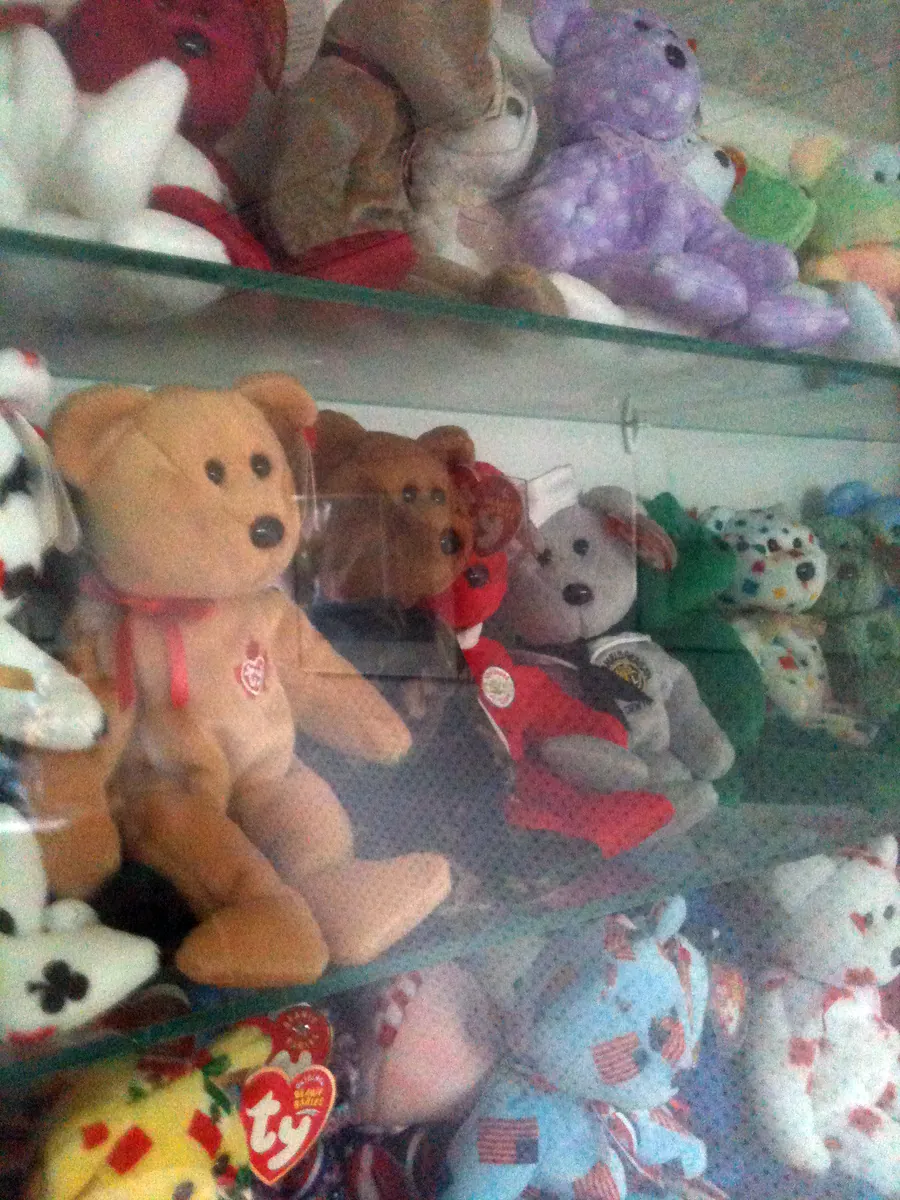
A display of Ty Beanie Baby bears
Value depends on the exact character, tags, and condition, not on a viral asking price
A cabinet of Ty Beanie Baby bears. Hang tags, tush tags, and whether the toy was a common or a scarcer style usually matter more than a spectacular listing. Online asking prices in this category are often optimistic. Photo: Mom's Beanies (9120344523).jpg by daryl_mitchell, licensed under CC BY-SA 2.0, via Wikimedia Commons. See also photo credits.

Most Beanie Babies are not a retirement plan. They are 1990s plush toys, and the usual selling picture today is modest. A few versions, especially unusual tags or fills, can do better than that. Viral asking prices, including six-figure eBay listings, are not the same thing as a sale.
A Mental Floss article by Lorna Wallace, dated 21 August 2024, put this in plain terms. The vast majority of Beanie Babies are only worth a couple of dollars at most these days, while a few sometimes sell for bigger sums. That article is a reported overview, not a live catalogue for every typo on a swing tag, and it is not a 2026 price list. It is a better starting point than a screenshot of a million-dollar listing.
The Princess the Bear example, with dated figures
Princess the Bear, the purple commemorative Beanie Baby issued after the death of Diana, Princess of Wales, is the toy people most often hope is valuable. Mental Floss (21 August 2024) reported that it is far more common for these bears to go for around $5 to $20, even though you can still find eye-watering asking prices online, including listings as high as $1 million. The article is careful to say that an asking price is not a sale.
The same piece noted that on rare occasions the bear has sold for figures in the thousands, sometimes up to $25,000. It also summarised tycollector.com's breakdown of the scarcer Princess versions (including an Indonesian-made bear with a no-space swing tag, a Canadian customs tush tag, and PVC pellets rather than the more common PE pellets) and reported that even in mint condition that version is only valued at $100 to $200. Those are figures published in that August 2024 article, not a live appraisal of the toy in your cupboard, and not an offer to buy.
The useful lesson is not a single Princess number. It is that tag details and fill can change the market, that mint examples and worn playthings are different, and that a spectacular listing can be wishful. If you want a current picture for the exact toy in your hand, identify the name, the tags, and the condition, then look at recent sold or current listings, or scan it with the app.
What actually moves the price
Start with the animal name and the generation. Ty produced a large number of designs, and many were made in huge quantities after the craze took hold. A common later example in loose condition usually sits in that “a couple of dollars at most” area described by Mental Floss, unless you have a documented scarce variant.
Tags matter more than almost anything else you can photograph. Collectors look at the heart-shaped swing (hang) tag and the tush tag sewn into the seam: the generation of the tag, whether it is still attached, creases or punch holes, and small text differences, including spacing and misspellings. Do not peel the tags off to make the toy look tidier. A Beanie Baby without tags is usually a harder sell, and it can be much harder to tell a scarce version from a common one.
The pellets inside also distinguish some early pieces from later ones. Older examples were often filled with PVC pellets; later ones often used PE pellets. That is a detail for identification, not something to open the toy to check unless you already know what you are doing. Condition of the plush, stains, smoke, and whether the toy is still in a protective tag cover all move the range as well.
We will not invent a price for a name we have not matched to listings, and we will not treat a single asking price as a sold result. If listings are thin for a particular variant, the honest answer is a wider range or a clearly labelled rough estimate, not a made-up precise figure.
How to photograph one, and how a scan helps
Photograph the whole toy, then a close photo of the swing tag (both sides if you can do that without stressing the tag) and the tush tag. If the name is hard to read, add a photo in even light. Do not wash the toy or iron a creased tag for the picture.
Then use the scan box on this page, or the app, and confirm the name and any tag details if anything looks off. We look at current public listings for that item and show a Worth about figure and a listed range when we find enough of them. If we cannot find enough listings, we say so. There is no Beanie-specific catalogue in the pricing mix in the way Numista sits behind coins, so the listings themselves do more of the work. The short version of that process is on How we price.
If you have a box of them, start with toys that still have both tags, older-looking tags, or names you remember as “special” releases, then scan those first. A common loose example is still worth identifying so you are not pricing it off a headline. For other finds in the same cupboard, you can return to the homepage and pick a guide, or start with a photo in the scan box.
Princess the Bear, in brief
Mental Floss (21 August 2024) reported that it is far more common for Princess the Bear to go for around $5 to $20, that rare sales have reached the thousands and sometimes $25,000, and that tycollector.com valued a scarce tag-and-fill variant at $100 to $200 mint. Those figures are from that article, not a live catalogue of the toy in your cupboard.
Tags, fill, and condition do more work than a headline. Do not peel the tags off. Asking prices on marketplaces can be wishful. When you sell, a local listing or a draft to eBay, Facebook Marketplace, or Gumtree is more realistic than a million-dollar ask. Beanie Babies is a trademark of Ty Inc.; this site is not affiliated with Ty.
The app scans faster, keeps a history of your items and gives free weekly scans.
What makes How Much Is It Worth different
One photo is enough to start, and you can add up to two more angles. We identify the item first, you confirm or correct it, then we look up a Worth about figure and a listed range from current public marketplace listings. Those are asking prices, which can sit above what a piece finally sells for. You see the listings themselves when we find enough of them.
Coins and banknotes also draw on Numista. Trading cards use PokéWallet, with a source credit where that data appears. Gold and silver use a live metal price as a floor. If listings are thin, we show a clearly labelled rough estimate rather than inventing a precise number. The app can draft a listing for eBay, Facebook Marketplace, or Gumtree once you are ready to sell. For the short version of this process, read How we price.
FAQ
How much is a Beanie Baby worth?
A Mental Floss article dated 21 August 2024 said the vast majority of Beanie Babies are only worth a couple of dollars at most these days, while a few sometimes sell for more. Tag details, fill, and condition can change that picture. Spectacular asking prices are not the same as sold prices.
How much is a Princess Diana Beanie Baby worth?
Mental Floss (21 August 2024) reported that it is far more common for Princess the Bear to go for around $5 to $20, even though some listings ask far more. It also noted rare sales in the thousands, sometimes up to $25,000, and a tycollector.com valuation of $100 to $200 mint for a scarce tag-and-fill variant. Those are figures from that article, not a live appraisal of your toy.
Do the tags matter?
Yes. Collectors look at the swing tag and the tush tag, including generation, condition, and small text differences. Do not peel the tags off. A toy without tags is usually harder to identify and harder to sell.
Can I scan a Beanie Baby with the app?
Yes. Photograph the toy and both tags, confirm the name and any tag details, and we will look at current public listings. If listings are thin for a particular variant, we say so instead of inventing a precise number.
Related guides
Sources
- Lorna Wallace, “The History and Value of the Princess Diana Beanie Baby,” Mental Floss, 21 August 2024. Most Beanie Babies worth a couple of dollars at most; Princess typically around $5 to $20, with rare higher sales and a reported $100 to $200 mint valuation for a scarce variant.
Beanie Babies is a trademark of Ty Inc. This site and the How Much Is It Worth app are not affiliated with, endorsed by, or sponsored by Ty Inc. We do not claim otherwise.
Updated 11 November 2026. Written by Harris, who built How Much Is It Worth. Figures that we cite include a source and a date. They are not a certified appraisal. See How we price.
The app scans faster, keeps a history of your items and gives free weekly scans.
See all guides on the homepage, or read how we price.