How we price an item starts with a photo. How Much Is It Worth estimates value by identifying the item, then looking at current public listings, a metal melt figure, or a labelled rough estimate when data is thin. Listings are asking prices, not a sold-price database. The result is a practical first look, not a formal appraisal or a guaranteed offer.
The app scans faster, keeps a history of your items and gives free weekly scans.
Example scan
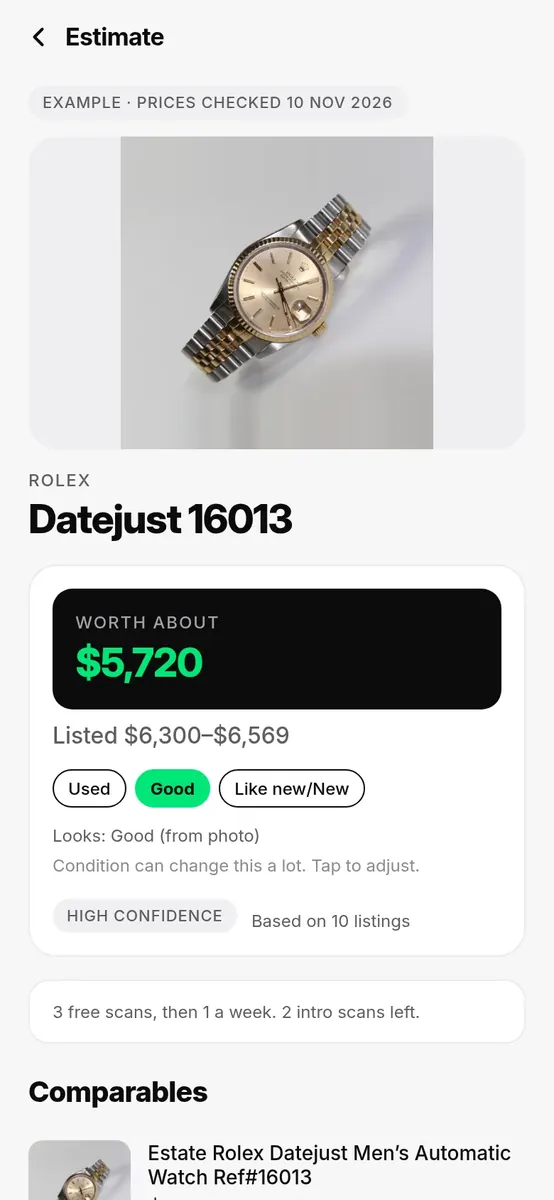
A photo check in the How Much Is It Worth app
We identify the item first, then look at current public listings rather than inventing a single number
This screenshot is from our own app, showing a vintage Datejust 16013 scan. You confirm the identification, then we show a Worth about figure and a listed range when we find enough current listings. In-app example from How Much Is It Worth. See also photo credits.
What a scan does
You photograph the item, or more than one side of it. The app tries to identify it: a coin date and mint mark, a card name and set, a hallmark, a model label, or another useful mark. Then it looks up a figure and shows you a result. That result is an estimate. It is not a formal appraisal, not an insurance valuation, and not an offer from us to buy the item.
A good photo still matters. A sharp, well-lit picture of the date, the serial, or the mark is more useful than a distant shot of a whole drawer. If identification is uncertain, we say so rather than inventing a precise number.
Listings, asking prices and sold prices
When we can, we look at current public listings for similar items. Those listings are asking prices: what a seller hopes to get. A sold price, when you can find one, can be lower, sometimes by a lot, especially if a listing has sat, if the condition was overstated, or if a dealer price is not a private-sale price. How Much Is It Worth is not a sold-price database. We do not claim to show confirmed auction-hammer results for every item, and we will not pretend an asking-price range is the same as a sold comp.
When we find enough listings, we show a range so you can see the spread. When listings are thin, we label a rough estimate rather than inventing a precise figure. That label is intentional. A rough estimate is more honest than a made-up "exact" number.
What the labels mean
"Worth about" is the headline estimate for the item we identified. "Listed range" is the spread of current public asking prices when we have enough of them. "Rough estimate" means the data is thin or the identification is only a first pass. "Floor" is used when a metal melt figure is the honest lower bound, not a likely collector sale. If a label is on the screen, read it. It is there so the figure is not mistaken for a guaranteed payout.
When we use a metal price as a floor
For gold and silver coins, bars, and jewellery, a live metal price can set a floor: the melt value of the precious metal in the piece, before anyone pays a premium for rarity, condition, or design. Melt is not a collector price, and it is not automatically what a scrap dealer will pay, because a dealer bid is often below a simple melt calculation. We cite the metal source when we use it. On 10 November 2026 at 6:55 p.m. Eastern, NGC's coin melt-value table listed a gold ask of $4,037.54 per troy ounce and a silver ask of $51.62. Earlier the same day, at 6:30 p.m. Eastern, the same table listed gold at $4,037.80 and silver at $51.63. Figures move, so the date and time of the snapshot matter.
A copper wheat cent or a clad Susan B. Anthony dollar does not have a useful silver floor. A 90 percent silver Morgan dollar does. We will not apply a melt figure to a coin that is not that metal.
Categories we can help with
Coins, banknotes, trading cards, gold and silver items, jewellery, watches, stamps, everyday collectibles, and some electronics are the kinds of things people scan. The guides on this site go deeper on particular items, and the hubs for coins, cards, and gold and silver gather those pages, along with collectibles and electronics guides. A first-look estimate is still a first look: we cannot grade a diamond from a phone photo, and we cannot confirm every error coin or luxury watch as genuine from one picture.
What this is not
This is not a formal appraisal. It is not an insurance valuation. It is not a cash offer, and we do not buy your items. A shop, a dealer, or a pawn counter may quote a different number because they need a margin or they are bidding on a different basis. For a high-value, insured, or legally sensitive item, get a professional opinion as well as a scan.
Sources we credit
Coin figures in the app also draw on Numista, shown with a source credit where that data appears. Trading card prices use PokéWallet for supported card games, also shown with a credit. Metal floors use a live metal price, and we cite the snapshot when we write about melt on this site. Public listings are asking prices from the live web. Those credits belong on the result when we use the data, and they belong here so you know what sits behind a number.
How to get a better estimate
- Photograph both sides, and crop so the date, mint mark, serial, hallmark, or model label is sharp.
- Add a second photo if the first one is dark, cropped, or missing a back or a mark.
- Read the identification on the result, and correct it if the app has the wrong year, set, or model.
- Use the listed range as asking prices, and look at sold listings yourself if you need a tighter sale expectation.
- For gold and silver, treat melt as a floor, not as the likely collector price.
You can start with a free web scan from this page, or open the coin guide or what's it worth if you want a walkthrough first.
The app scans faster, keeps a history of your items and gives free weekly scans.
What makes How Much Is It Worth different
One photo is enough to start, and you can add up to two more angles. We identify the item first, you confirm or correct it, then we look up a Worth about figure and a listed range from current public marketplace listings. Those are asking prices, which can sit above what a piece finally sells for. You see the listings themselves when we find enough of them.
Coins and banknotes also draw on Numista. Trading cards use PokéWallet, with a source credit where that data appears. Gold and silver use a live metal price as a floor. If listings are thin, we show a clearly labelled rough estimate rather than inventing a precise number. The app can draft a listing for eBay, Facebook Marketplace, or Gumtree once you are ready to sell. For the short version of this process, read How we price.
FAQ
How do you price an item from a photo?
We identify the item first, then look at current public listings, a metal melt figure where it applies, or a labelled rough estimate when data is thin. You can confirm or correct the identification before you trust a number. The result is a practical first look, not a formal appraisal.
Is a listed price the same as a sold price?
Not always. The listings we use are asking prices: what a seller hopes to get. A sold price can be lower. How Much Is It Worth is not a sold-price database, and we will not pretend an asking-price range is the same as a confirmed sale.
What is a rough estimate?
It is a labelled figure we use when listings are thin or the identification is only a first pass. The label is intentional. A rough estimate is more honest than a made-up exact number.
Do you buy items, or is this an appraisal?
No. We do not buy your items, and a scan is not a formal appraisal or an insurance valuation. A shop or dealer may quote a different number because they need a margin or they bid on a different basis.
When do you use a metal price?
For gold and silver coins, bars, and jewellery, a live metal price can set a floor: the melt value of the precious metal, not a collector premium and not automatically a scrap dealer's payout. We cite the snapshot when we write about melt on this site.
Guides to keep going
Sources
- NGC, Coin Melt Values, updated 10 November 2026 at 6:55 p.m. Eastern. Gold ask $4,037.54 per troy ounce; silver ask $51.62. An earlier snapshot the same day, at 6:30 p.m. Eastern, listed gold at $4,037.80 and silver at $51.63.
- Coin figures in the app also draw on Numista. Trading card prices use PokéWallet for supported card games, shown with a source credit where that data appears.
Updated 11 November 2026. Written by Harris, who built How Much Is It Worth. Figures that we cite include a source and a date. They are not a certified appraisal. See How we price.
The app scans faster, keeps a history of your items and gives free weekly scans.
See all guides on the homepage, or read how we price.