Wheat penny value is usually modest. A PCGS article dated 7 September 2023 said most circulated Lincoln wheat cents are worth three to five cents each, a small premium over the one-cent face value set by the United States Mint. A few dates, mint marks, and errors sit in a different market.
The app scans faster, keeps a history of your items and gives free weekly scans.
Example
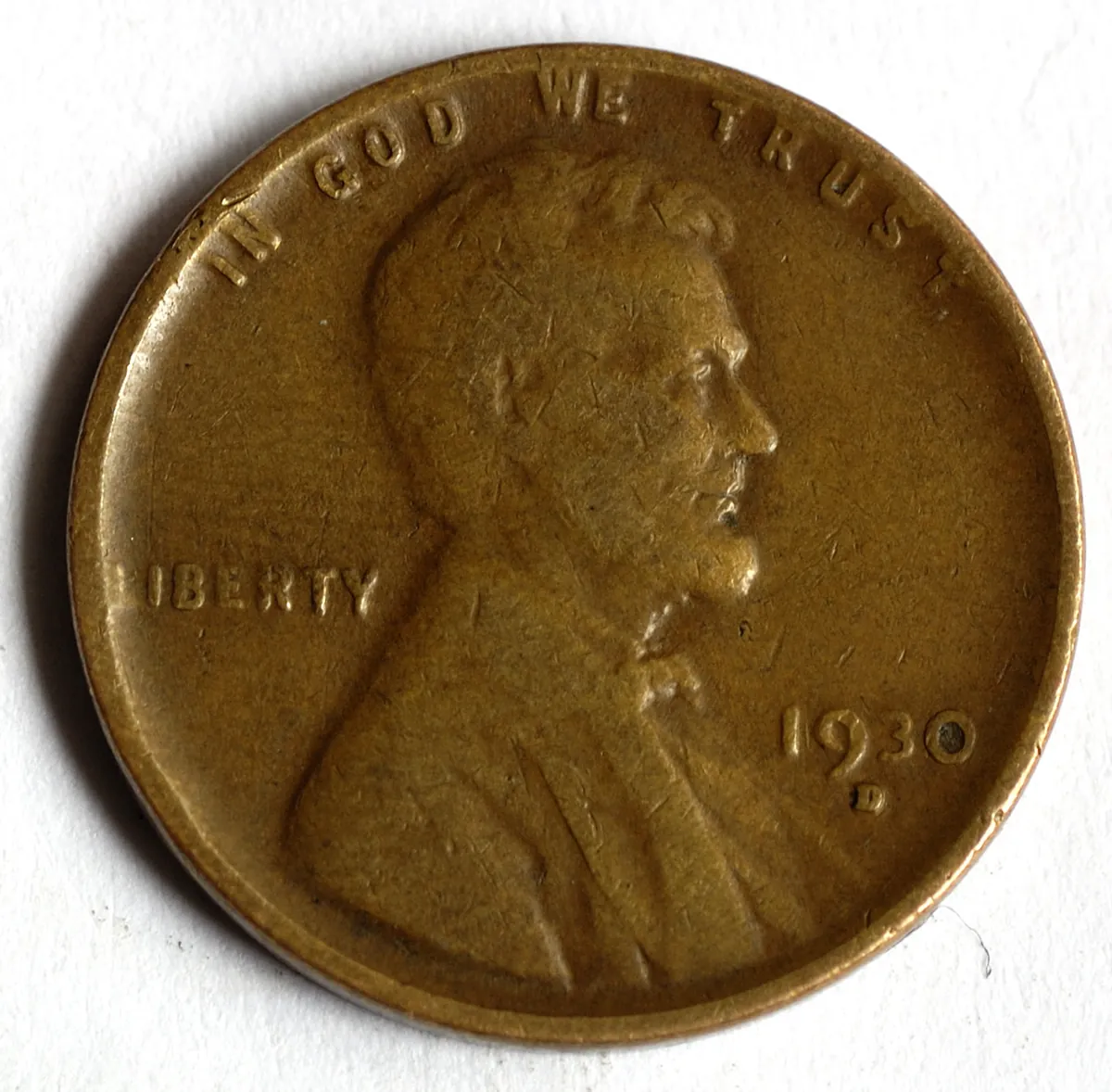
1930-D Lincoln wheat penny, circulated
Most circulated wheat cents: about 3 to 5 cents (PCGS, 7 September 2023)
A typical worn wheat penny from the 1909-1958 Lincoln wheat series. Date, mint mark, and condition can still move a particular coin. That PCGS range is a 2023 published comment, not a live 2026 price list. Photo: Wheat cent 1930 (2).jpg by Doronenko, licensed under CC BY 3.0, via Wikimedia Commons. See also photo credits.

A wheat penny is a Lincoln cent struck from 1909 through 1958 with two ears of wheat on the reverse. Most of the ones that turn up in a jar are common dates in circulated condition.
A PCGS article by Victor Bozarth, dated 7 September 2023, said most circulated Lincoln wheat cents are worth three to five cents each. That is a small premium over the one-cent face value described by the United States Mint, not a windfall. The article is a useful starting point from a major grading service, but it is not a live price list for 2026. If you want a current picture for the exact date in your hand, identify it and then look at recent listings, or scan it with the app.
How to tell what you have
Turn the coin over. A wheat penny has ONE CENT and UNITED STATES OF AMERICA with two wheat stalks. Lincoln Memorial cents (1959 through mid-2008) and later shield cents are different series and should not be priced as wheat cents.
Read the date on the obverse, under LINCOLN. The mint mark, when there is one, sits below the date: D for Denver, S for San Francisco, and no mint mark for Philadelphia on this series. A worn date is still worth recording honestly. If you cannot read it, say so when you confirm a scan rather than guessing a scarce year.
Some 1909 cents also have the designer's initials VDB on the reverse, at the bottom between the wheat stalks. The combination of a 1909 date, an S mint mark, and those initials is the well-known 1909-S VDB, which is a different market from a common 1950s wheat cent.
Common dates versus key dates
The bulk of wheat cents from the later years of the series were struck in very large numbers. In circulated condition they usually sit in that modest three-to-five-cent area described by PCGS in 2023, or close to it, unless the coin is in unusually sharp condition or has a notable error.
A few dates are collected as keys. On 11 November 2026 we checked the Numista entry for the 1909-S VDB Lincoln cent (N#5700). Numista lists a mintage of 484,000 and publishes CDN CPG indication prices of $760 in grade G4 and $975 in grade F12, courtesy of CDN Publishing, as an indication of retail value only. Those figures are not an offer to buy, and they are not a live lookup each time you load this page.
Other dates and varieties that collectors routinely treat as scarcer include the 1909-S (without looking only at the VDB initials), 1914-D, 1922 Plain (no D), 1931-S, and the 1955 doubled die obverse, along with major striking errors. We are not publishing made-up prices for those coins here. If you think you have one, compare it with a current specialist guide and with recent listings, and consider a professional opinion before you sell or insure it.
The 1943 steel cent, and the bronze error
In 1943 the Mint struck Lincoln cents in zinc-coated steel because copper was needed for the war effort. Those coins are magnetic and have a grey, silvery look rather than a copper colour. The same PCGS article dated 7 September 2023 said a typical 1943 steel cent is worth about eight to fifteen cents. That is a 2023 published range, not a live ticker.
A much scarcer 1943 bronze (copper-alloy) cent exists as an error. It will not stick to a magnet in the way a steel cent does. Because that error is famous, it is also widely faked, including by copper-plating a steel cent or altering a date. Do not assume a copper-coloured 1943 in a jar is the error coin. If a magnet does not attract it, have it authenticated by a respected grading or authentication service before you treat it as a rarity.
Condition, cleaning, and photographs
Do not clean a wheat penny. Collectors would rather see original surfaces, even if they are brown or spotted, than a coin that has been polished, dipped, or scratched with a pad. Cleaning usually lowers the price a collector will pay.
Photograph both sides in even light, with the date and mint mark sharp, and without heavy glare. A second photo cropped to the date helps. Then use the scan box on this page, or the app, and confirm the year and mint mark before you read a range. Coin and banknote figures in the app draw on Numista as well as current public listings.
If the coin is a common date, a scan is still useful: it can confirm that you do not have a key date, and it can show you what common pieces are actually listed for. If it is a key date or a possible error, treat the estimate as a starting point and get a specialist view for insurance or a high-stakes sale. For the wider coin process, see how much is my coin worth.
Key dates at a glance
| What to look for | What we can say from sources |
|---|---|
| Common circulated wheat cents (1909-1958, later dates especially) | PCGS, 7 September 2023: typically three to five cents. That article is not a live 2026 list. |
| 1943 steel cent (magnetic, grey) | Same PCGS article: typically about eight to fifteen cents. |
| 1909-S VDB | Numista, checked 11 November 2026: mintage 484,000; CDN CPG indication $760 in G4 and $975 in F12, indication only. |
| Other keys (1909-S, 1914-D, 1922 Plain, 1931-S, 1955 doubled die, 1943 bronze error) | Scarcer, and often faked. We do not invent prices. Check a current guide, recent listings, or a professional authenticator. |
Selling, fakes, and where you are
Asking prices on public listings can sit above a sale, especially for worn common dates. A coin shop may pay close to the modest common-date range. Key dates should not be sold on the strength of a jar find until they are authenticated, because altered mint marks and copper-plated steel cents show up often.
These notes are for United States cents. If you are in the UK, Australia, or Canada, a wheat cent is still a US coin; a scan can use public listings, and any cited figures here are in US dollars from US sources. The app can draft a listing for eBay, Facebook Marketplace, or Gumtree.
The app scans faster, keeps a history of your items and gives free weekly scans.
What makes How Much Is It Worth different
One photo is enough to start, and you can add up to two more angles. We identify the item first, you confirm or correct it, then we look up a Worth about figure and a listed range from current public marketplace listings. Those are asking prices, which can sit above what a piece finally sells for. You see the listings themselves when we find enough of them.
Coins and banknotes also draw on Numista. Trading cards use PokéWallet, with a source credit where that data appears. Gold and silver use a live metal price as a floor. If listings are thin, we show a clearly labelled rough estimate rather than inventing a precise number. The app can draft a listing for eBay, Facebook Marketplace, or Gumtree once you are ready to sell. For the short version of this process, read How we price.
FAQ
What is a wheat penny worth?
A PCGS article dated 7 September 2023 said most circulated Lincoln wheat cents are worth three to five cents each. That is a modest premium over the one-cent face value. A few dates, mint marks, and errors are scarcer and should be checked against a current guide or recent listings, not against that typical range.
How much is a 1943 steel penny worth?
The same PCGS article (7 September 2023) said a typical 1943 steel cent is worth about eight to fifteen cents. That article is not a live 2026 price list. A 1943 bronze cent is a well-known error and is a different, much scarcer coin; do not assume you have one without a careful check, ideally by a professional authenticator.
Which wheat pennies are the valuable ones?
Collectors look first at dates and mint marks such as the 1909-S VDB, 1909-S, 1914-D, 1922 Plain (no D), 1931-S, and the 1955 doubled die, plus major errors. Numista, checked on 11 November 2026, lists a 1909-S VDB mintage of 484,000 and publishes CDN CPG indication prices of $760 in grade G4 and $975 in grade F12. Other key dates should be checked in a current guide. We do not invent prices for dates we have not sourced.
Should I clean a wheat penny before I sell it?
No. Cleaning a coin usually lowers collector value, even if the coin looks shinier in a photo. Photograph it as it is, and mention wear or damage when you confirm the identification.
Can I scan a wheat penny with the app?
Yes. Photograph both sides, including the date and mint mark, then confirm the identification. Coin figures draw on Numista as well as current public listings. See How we price for the short version of that process.
Related coin and money guides
Sources
- Victor Bozarth, “7 of the Most Frequently Asked Coin Questions,” PCGS, 7 September 2023. Circulated Lincoln wheat cents typically three to five cents; typical 1943 steel cents about eight to fifteen cents.
- United States Mint, Penny (circulating coin) and coin specifications, for face value and modern circulating composition. Accessed 11 November 2026.
- Numista, Lincoln Cent, 1909-S VDB (N#5700), mintage 484,000; CDN CPG indication prices $760 (G4) and $975 (F12), courtesy CDN Publishing. Checked 11 November 2026.
Updated 11 November 2026. Written by Harris, who built How Much Is It Worth. Figures that we cite include a source and a date. They are not a certified appraisal. See How we price.
The app scans faster, keeps a history of your items and gives free weekly scans.
See all guides on the homepage, or read how we price.