Indian Head penny value depends on date, mint mark and condition. An Indian Head Cent was struck from 1859 to 1909. Some dates are common in worn grade and others are scarce, so you should read the date and mint before you assume you have a rarity.
The app scans faster, keeps a history of your items and gives free weekly scans.
Example
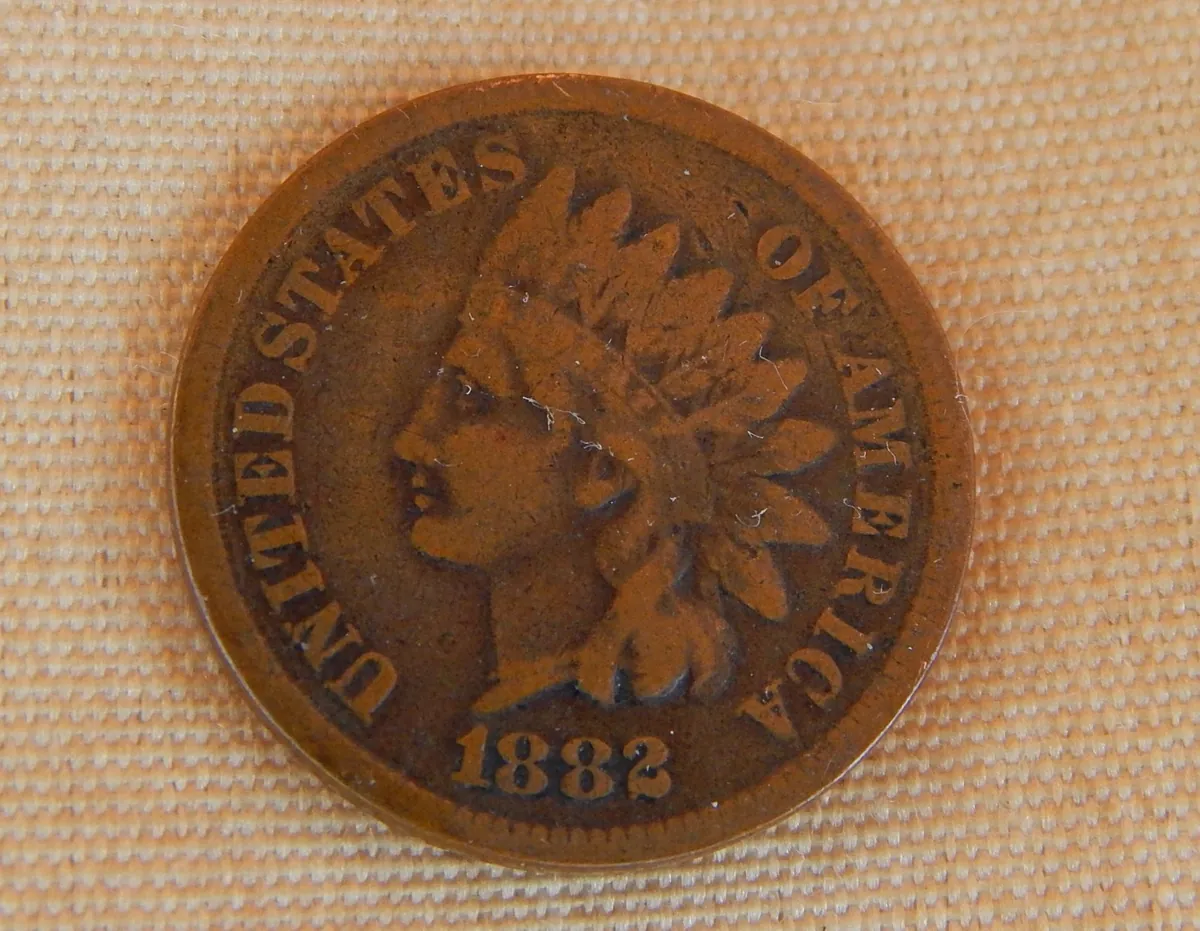
1882 Indian Head penny, circulated obverse
Value depends on date, mint mark, and condition
Indian Head cents were struck from 1859 to 1909. A worn common date is usually a modest sale, while key dates and sharper coins can sit well above that. We do not invent a year-by-year chart. Photograph both sides, including the date and any mint mark, then compare current listings. Photo: 1882 Indian head penny one cent.jpg by Ron Clausen, licensed under CC BY-SA 4.0, via Wikimedia Commons. See also photo credits.

What an Indian Head Cent is (1859-1909)
The Indian Head Cent is a United States one-cent coin. The common name is Indian Head penny. The series runs from 1859 to 1909, after the short Flying Eagle cent and before the Lincoln wheat cent that began in 1909. Face value is one cent, as listed by the United States Mint. That floor does not tell you much about a nineteenth-century copper coin, but it is the legal-tender starting point.
A worn common date can be a modest seller. A scarce date or a sharp, original-colour piece is a different market. We will not invent a year-by-year price chart. Identify the coin first, then look at current public listings or a specialist catalogue.
How to read date and mint mark
The date is on the obverse, at the bottom of the portrait. Most Indian Head cents have no mint mark and were struck at Philadelphia. The San Francisco mint mark, a small S, appears on the reverse, below the wreath, and only on some 1908 and 1909 coins. Those S-mint dates are the ones people hunt for in a mixed lot. Not sure which mint mark you have? Snap it and the app reads it for you. Do not scratch the reverse to "find" an S.
High-interest years as sections, no invented prices
Collectors look first at dates such as 1877, 1908-S, and 1909-S, and at a few earlier low-mintage years and varieties. Those names show up often in search queries and in "valuable pennies" lists. A date being famous is not the same as the coin in your hand being genuine or high grade. We do not invent prices for those dates. Check a current specialist guide, recent listings, or a professional authenticator if a lot of money is at stake.
Later common dates, especially in the 1900s, show up in jars far more often than the keys. A 1907, for example, is a date people search because they have one, not because every 1907 is a rarity. Read the date, then compare listings for that date and grade, rather than a headline list.
The Flying Eagle cent of 1856 to 1858 is a short cousin series, not an Indian Head cent. If the portrait is an eagle in flight, you are on a different coin.
Condition and colour
Copper shows colour as well as wear. A brown circulated coin, a red-brown uncirculated coin, and a full red specimen are not the same listing set. Wear on the ribbon, the feathers, and the word ONE on the reverse is a practical place to look. Do not clean an Indian Head cent to brighten a photo. Cleaning usually lowers collector value.
Common vs scarce dates
Many dates in this series are available in worn grade. Scarcer dates and high-grade common dates sit in a collector market. Social posts sometimes treat every Indian Head penny as a treasure. The honest answer to "are they worth money?" is yes, often a little, and only sometimes a lot. A photo check and a confirmed date are more useful than a rumour.
Listed vs sold
The range we show comes from current public listings, which are asking prices. A sold price can be lower. When we find enough listings, we show them so you can see the spread. Catalogue indications, when we cite them, include a source and a date, and they are not a live offer to buy.
Where to sell
A local coin shop is often the practical route for common circulated dates. Key dates and high-grade coins may belong with a specialist or in a public listing. The app can draft a listing for eBay, Facebook Marketplace, or Gumtree. Cited remarks here are in US dollars when a figure appears. If you are in the UK, Australia, or Canada, a scan can still help you identify the coin.
Fakes and altered dates
Added mint marks and altered dates show up on this series, especially on the famous S-mint coins and on 1877. Compare letter shapes, mint-mark position, and the weight with a known genuine example if a price looks too good. If a large sum is at stake, get the coin authenticated before you sell it as a key date.
Scan and list
- Photograph both sides, with the date and the area below the wreath readable.
- Confirm the year and mint mark, and say if the colour or wear looks different from the photo.
- Review the Worth about figure and the listed range when we find enough current public listings. Coin figures also draw on Numista. See How we price.
You can start with a free web scan in the box on this page.
Flying Eagle cents, struck just before this series, are a cousin denomination and should not be priced from an Indian Head listing. If the portrait is an eagle rather than the Indian Head design, you have a different coin. For Indian Head cents, colour in uncirculated grade (brown, red-brown, or red) can move a collector price, but a worn pocket piece is usually judged first by date, mint, and honest wear. We will not invent a year-by-year chart. A scan is a way to read the date and mint mark and then look at current public listings, with Numista as a coin source in the app.
The app scans faster, keeps a history of your items and gives free weekly scans.
What makes How Much Is It Worth different
One photo is enough to start, and you can add up to two more angles. We identify the item first, you confirm or correct it, then we look up a Worth about figure and a listed range from current public marketplace listings. Those are asking prices, which can sit above what a piece finally sells for. You see the listings themselves when we find enough of them.
Coins and banknotes also draw on Numista. Trading cards use PokéWallet, with a source credit where that data appears. Gold and silver use a live metal price as a floor. If listings are thin, we show a clearly labelled rough estimate rather than inventing a precise number. The app can draft a listing for eBay, Facebook Marketplace, or Gumtree once you are ready to sell. For the short version of this process, read How we price.
FAQ
How much is an Indian Head penny worth?
It depends on the date, the mint mark, and the condition. Many worn common dates are modest collector coins, not a fortune. A few dates, including 1877, 1908-S, and 1909-S, are scarcer and should be checked against current listings and a specialist guide. We do not invent year-by-year prices.
What years of Indian Head pennies are valuable?
The dates collectors mention first are 1877, 1908-S, and 1909-S, plus high-grade or unusual-colour pieces of other years. Most circulation-worn dates are more modest. Read the date and mint before you assume you have a rarity, and be careful of altered dates on famous years.
Are Indian Head pennies worth money?
Often yes, in the sense that many are worth more than one cent, but that is not the same as a high headline price. Value still depends on date, mint, and condition. A worn common date can be a small collector sale, not a key-date price.
Are Indian Head pennies the same as wheat pennies?
No. Indian Head cents were struck from 1859 to 1909. Lincoln wheat pennies began in 1909 and ran through 1958. They are different series. If you have a Lincoln wheat reverse, use the wheat penny guide rather than this page.
Can I scan an Indian Head penny with the app?
Yes. Photograph both sides, including the date and any mint mark, then confirm the identification. Coin figures draw on Numista as well as current public listings. See How we price.
Related coin guides
Sources
- United States Mint, Penny (circulating coin) and coin specifications, for face value of the cent. Accessed 11 November 2026.
- How the app prices coins is described on How we price. Coin figures also draw on Numista.
Updated 11 November 2026. Written by Harris, who built How Much Is It Worth. Figures that we cite include a source and a date. They are not a certified appraisal. See How we price.
The app scans faster, keeps a history of your items and gives free weekly scans.
See all guides on the homepage, or read how we price.