What is it worth? The same practical question as “how much is it worth.” You have an object in front of you, and you want a current selling picture for that specific item and condition, not a remembered headline.
The app scans faster, keeps a history of your items and gives free weekly scans.
Example scan
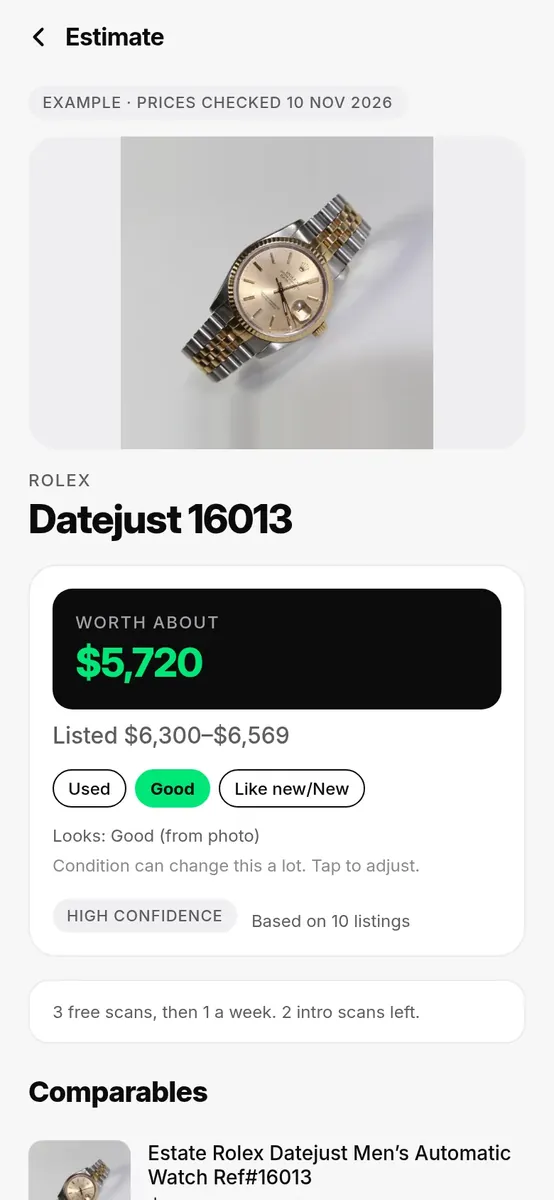
A photo check in the How Much Is It Worth app
The app identifies the item, then shows a Worth about figure and a listed range when it finds enough current listings
This screenshot is from our own app, showing a vintage Datejust 16013 scan. Worth can mean face value, metal value, a current listed range, or a professional appraisal, and those figures are not interchangeable. Estimates are not a certified appraisal. In-app example from How Much Is It Worth. See also photo credits.
“What is it worth?” is the same practical question as “how much is it worth?” You have an object in front of you, and you want a current selling picture, not a remembered headline or a confident guess with no listings behind it.
The useful answer is almost never a single universal number for a name (“a coin,” “a card,” “a toy”). It is a range for this item, in this condition, in the market as it stands now. That is why a photo, a careful identification, and current public listings do more work than a search for a famous price.
What “worth” can mean
People use the word in at least four ways, and mixing them up is how you get a misleading answer.
Face value or replacement cost is one meaning. A circulating United States quarter is still twenty-five cents at the till. A mint postage stamp can be worth its current postage if you use it to mail a letter. That floor matters, but it is not the collector or resale figure.
Metal value is another. Older silver dimes and quarters, wartime silver nickels, and gold bars have a melt floor that moves with the published spot price. On this site, denomination guides cite NGC's melt-value table with the date of the snapshot we checked, and the app uses a live metal price as a floor for gold and silver. Melt is not automatically what a collector will pay for a scarce date in sharp condition, and a jewellery payout is not the same as a branded one-ounce bar.
Listed or asking price is what you see on public marketplaces and shops right now. That is the main picture this site is built to show: a Worth about figure that sits within a range of current listings for the same item, once you have confirmed the identification. Asking prices can sit above what a piece finally sells for, which is why a range, and the listings themselves, are more honest than one big number.
Sold prices, insurance appraisals, and dealer offers are yet another set of figures. A formal appraisal for insurance or estate use is a professional document; an estimate on this site is not that. A shop offer can be lower than a listed retail range because the shop has to resell the item. If you need an appraisal, or you are making a high-stakes decision, treat a scan as a first look and then talk to a qualified specialist.
Why a photo beats a name alone
Two objects that share a name can sit in completely different markets. A first-edition Pokémon card and an unlimited print of the same card are not interchangeable. A 1964 Washington quarter is 90 percent silver; a 1965 quarter from circulation is clad. A Beanie Baby with both tags and a scarce tag variety is not the same toy as a loose, untagged plaything. If you only ask “what is it worth?” and type the character or denomination, you are likely to land on a headline that belongs to a different version.
Condition does the same job. Collectors and buyers look at wear, completeness, packaging, grade, and signs of cleaning or repair. A price copied from a mint-state or professionally graded listing will not describe a worn example, and the reverse is also true.
So the practical sequence is: photograph the item (and the back, mark, date, or tag if you have one), confirm what it actually is, then look at current listings for that match. You can do that in the scan box on this page. Scan it with the app if you would rather work from your phone, or start with a free web scan here. If anything in the identification looks off, change it before you trust the range.
How we arrive at a number
After you confirm the identification, we compare current listings from online marketplaces and shops for that same item. The Worth about figure sits within the range of those real listings. Coins and banknotes also draw on Numista. Trading cards use PokéWallet, with a source credit where that data appears. Gold and silver use a live metal price as a floor. If we cannot find enough recent listings, we show a clearly labelled rough estimate instead of inventing a precise number. The short explanation is on How we price.
That is also the difference between this question and asking a chatbot what something is worth. A model answer can be out of date, it does not see the condition of your object, and it can sound sure when it is guessing. We use identification first, then current listings you can open yourself.
Where to go next if you already know the category
If you already know what you are holding, a short guide can tell you what usually moves the price and which figures we can cite with a source and a date:
- How much is it worth (the homepage, with a scan box at the top)
- Coin price guides for pennies, nickels, dimes, quarters, and $2 bills
- Card price guides for Pokémon and other trading cards
- Collectibles price guides for Beanie Babies and other finds
- Gold and silver price guides for bars, coins, and jewellery
If you do not know the category yet, you do not have to pick one. Start with a photo, confirm the identification, and read the range. These are estimates, not certified appraisals, and not an offer to buy. For a jar of mixed coins or a box of cards, scan the pieces that look oldest, tagged, graded, or unusual first, then decide whether the rest is everyday material.
If this page brought you here because you typed “what is it worth,” you are in the right place: take a picture, confirm what it is, and use a current listed range rather than a guess. People also search “what's it worth”; that phrasing is covered on the homepage, howmuchisitworth.today, which has the same scan box at the top.
Sold prices, asking prices, and where to sell
The range we show comes from current public listings, which are asking prices. A sold price, a dealer offer, and an insurance appraisal can all be different, and usually lower than the most optimistic ask. When we find enough listings, we show them so you can see the spread.
The app can draft a listing for eBay, Facebook Marketplace, or Gumtree. A formal appraisal is a separate professional job. If you already know the category, use a coin price guide, a card price guide, collectibles price guides, or gold and silver price guides.
The app scans faster, keeps a history of your items and gives free weekly scans.
What makes How Much Is It Worth different
One photo is enough to start, and you can add up to two more angles. We identify the item first, you confirm or correct it, then we look up a Worth about figure and a listed range from current public marketplace listings. Those are asking prices, which can sit above what a piece finally sells for. You see the listings themselves when we find enough of them.
Coins and banknotes also draw on Numista. Trading cards use PokéWallet, with a source credit where that data appears. Gold and silver use a live metal price as a floor. If listings are thin, we show a clearly labelled rough estimate rather than inventing a precise number. The app can draft a listing for eBay, Facebook Marketplace, or Gumtree once you are ready to sell. For the short version of this process, read How we price.
FAQ
What is it worth?
There is no single number that belongs to a name alone. Worth can mean face value, metal value, a current listed range, or a professional appraisal, and those figures are not interchangeable. The practical way to answer “what is it worth” is to identify the exact item and condition from a photo, then look at current public listings.
What if I only have a picture?
A picture is enough to start. Photograph the item, and the back, mark, date, or tag if you have one, then confirm the identification in the scan box on this page or in the app. We show a Worth about figure and a listed range when we find enough current listings. If listings are thin, we say so.
Is this different from “how much is it worth”?
No. They are the same practical question. This page is written around “what is it worth.” The homepage is written around “how much is it worth,” and it has the same scan box at the top.
Is a listed price the same as what it will sell for?
Not always. A listed or asking price is what sellers are advertising now. A sold price, a dealer offer, and an insurance appraisal can all be different. We show a range from current public listings, plus the listings themselves when we find enough of them, so you can see the spread rather than one headline number.
Are these figures a certified appraisal?
No. They are estimates based on identification plus current public listings or a specialist catalogue. They are not a certified appraisal, and they are not an offer to buy. Use a qualified specialist if you need an appraisal or you are making a high-stakes decision.
Guides to keep going
Updated 11 November 2026. Written by Harris, who built How Much Is It Worth. Figures that we cite include a source and a date. They are not a certified appraisal. See How we price.
The app scans faster, keeps a history of your items and gives free weekly scans.
See all guides on the homepage, or read how we price.