Pokémon card value
Set, edition, language, and condition, then a listed range from current public listings.
The app scans faster, keeps a history of your items and gives free weekly scans.
These card price guides start with the exact print in your hand: set, number, edition, and whether the card is raw or graded. Then snap a photo to check yours free.
Example scan · 10 Nov 2026
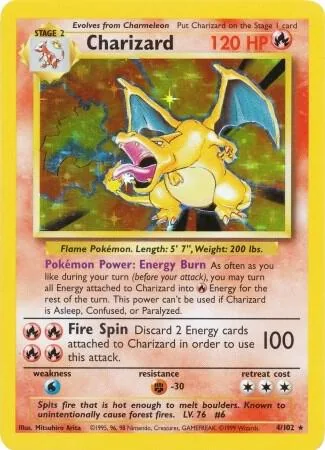
The exact set, edition, and whether the card is raw or graded all split the market
The same Base Set Charizard already used on this site, shown here as a card price guide example. A first-edition print and an unlimited print of the same name should not share one number. Card image from the PokéWallet Images API, hosted locally. Data by PokéWallet. The card artwork is the property of the rights holders. See also photo credits.
Card price guides on other sites often show a catalogue mid-point or a graded-price grid. That is useful, but only after you know the exact print. A first-edition Base Set card and an unlimited print of the same name should not share one number. Baseball, football, and basketball cards, plus Yu-Gi-Oh, MTG, and a Charizard from a specific Pokemon set, follow the same idea: the exact set, number, edition, and whether the card is raw or graded all split the market. Language, holofoil, and whether the card is in a graded slab also split the market.
We show current public listings, which are asking prices. A sold price can be lower. Condition is not a side note: centering, corners, edges, and surface wear can move a card from a high listing to a modest one. Do not clean a card to improve a photo. Fakes and proxies exist, especially for famous early cards, so compare printing, colour, and the back pattern with a known genuine copy if a price looks too good.
Collectors buy and sell worldwide. Listings you see may be in US dollars or in another currency depending on the market. The app can draft a listing for eBay, Facebook Marketplace, or Gumtree when you are ready to sell.
Set, edition, language, and condition, then a listed range from current public listings.
Photograph the front and back so the set and finish are readable, then confirm the identification.
Year, set, player, and whether the card is raw or graded. Many junk-wax cards sell for very little.
Set code, rarity, and first edition versus unlimited. Early sought-after prints are a different market.
Start here for baseball, football, and basketball cards: year, set, player, and raw versus graded.
Year, set, player, and condition, including why a true rookie and a later issue are different markets.
Year, set, player, and condition, including why a true rookie and a later issue are different markets.
Set, edition, and condition matter more than the name. A Base Set holofoil and a later reprint are different markets.
Exact card, set, finish, language, and condition, including reprints versus earlier reserved-list prints.
The app scans faster, keeps a history of your items and gives free weekly scans.
One photo is enough to start, and you can add up to two more angles. We identify the item first, you confirm or correct it, then we look up a Worth about figure and a listed range from current public marketplace listings. Those are asking prices, which can sit above what a piece finally sells for. You see the listings themselves when we find enough of them.
Coins and banknotes also draw on Numista. Trading cards use PokéWallet, with a source credit where that data appears. Gold and silver use a live metal price as a floor. If listings are thin, we show a clearly labelled rough estimate rather than inventing a precise number. The app can draft a listing for eBay, Facebook Marketplace, or Gumtree once you are ready to sell. For the short version of this process, read How we price.
They cover Pokémon cards and other trading cards, with the exact set, edition, language, and condition, plus whether a card is raw or graded. A first-edition print and an unlimited print are different markets.
Yes. Photograph the front and back, confirm the identification, and we will look up a listed range when we find enough current public listings. Trading card prices use PokéWallet, shown with a source credit where that data appears.
Not always. We show a range from current public listings, which are asking prices. A sold price can be lower. When we find enough listings, we show them so you can see the spread.
No. They are estimates from identification plus current listings or a specialist catalogue, not a certified appraisal and not an offer to buy.
You can also read How we price or start from the homepage.
Updated 11 November 2026. Written by Harris, who built How Much Is It Worth. Figures that we cite include a source and a date. They are not a certified appraisal. See How we price.
The app scans faster, keeps a history of your items and gives free weekly scans.