Kennedy half dollar value depends first on silver content and then on date, mint and condition. 1964 coins are 90 percent silver; many 1965 to 1970 coins have 40 percent silver; later clad coins are usually worth face value unless they are scarce varieties or high grade. Check the date before you sell.
The app scans faster, keeps a history of your items and gives free weekly scans.
Example · 10 Nov 2026
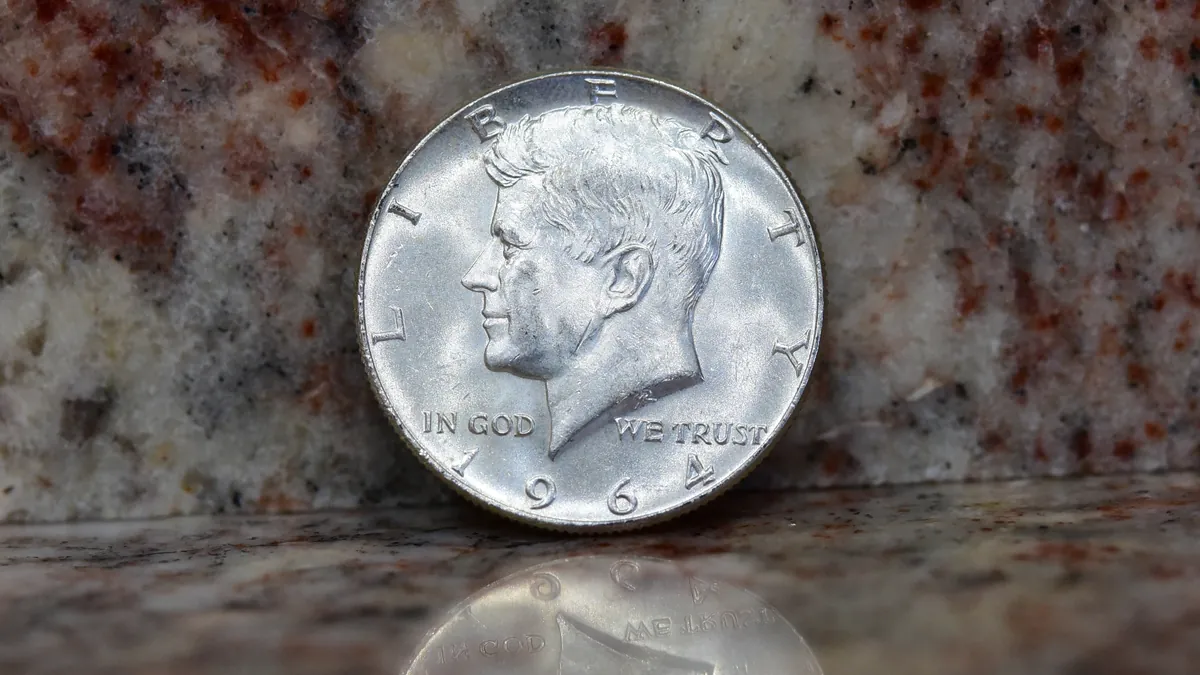
1964 Kennedy half dollar, the 90 percent silver first-year issue
Melt floor $18.67 (NGC, 10 November 2026, 6:55 p.m. Eastern)
1964 Kennedy halves are 90 percent silver. Later clad circulation strikes are usually close to face value unless they are a scarce variety or a high-grade collector coin. The NGC figure is a melt value, not a collector price, and not a live quote. Photo: 1964 Kennedy Half Dollar (54187367859).jpg by slgckgc, licensed under CC BY 2.0, via Wikimedia Commons. See also photo credits.

How to identify a Kennedy half dollar
The Kennedy half dollar has been struck since 1964. The obverse shows President John F. Kennedy. Circulation coins are fifty cents in face value, as listed by the United States Mint. To price one, start with the date, then the mint mark, then the condition. Not sure which mint mark you have? Snap it and the app reads it for you.
On 1964 coins the mint mark, if there is one, sits on the reverse, below the eagle. From 1968 onward it is on the obverse, under Kennedy's neck. Philadelphia circulation strikes had no mint mark in the early years of the series; a P mint mark appears later. Denver uses D. San Francisco proof and some special issues use S.
1964 90 percent silver
The first-year Kennedy half dollar is 90 percent silver and 10 percent copper, and it weighs 12.5 grams. NGC's melt-value table, updated 10 November 2026 at 6:55 p.m. Eastern, listed $18.67 for that coin (0.36169 troy ounces of silver). Melt is a floor. A sharp, proof, or scarce variety can sit above it. We do not invent year-by-year collector prices here. A 1964 issue is common as a date, so condition and whether it is a regular strike or a proof do more work than the year alone.
1965-1970 40 percent silver
From 1965 through 1970 the half dollar was reduced to an overall 40 percent silver, 60 percent copper composition, and the weight dropped to 11.5 grams. The same NGC table listed $7.63 for those coins (0.1479 troy ounces of silver). Mint marks were left off in 1965, 1966, and 1967. The 1970 circulation-style half was made for mint and proof sets rather than everyday change, so treat a 1970 date as something to identify carefully, not as a typical pocket-change find.
Clad years and the bicentennial
From 1971, circulating Kennedy halves are copper-nickel clad and usually sit at the fifty-cent face value in ordinary worn condition. The bicentennial coins of 1975 and 1976 are dated 1776-1976 and show Independence Hall on the reverse. Most of those from change are also clad and modest. A 40 percent silver bicentennial half exists as a collector issue; do not assume a bicentennial coin from a drawer is silver until you check the edge, the weight, or a specialist listing. Later proof and commemorative silver halves are a different market again. We will not invent a chart for those.
| Year group | What the sources say |
|---|---|
| 1964, 90% silver, 12.5 g | NGC melt $18.67 on 10 November 2026 (0.36169 troy oz silver). |
| 1965-1970, 40% silver, 11.5 g | NGC melt $7.63 on the same update (0.1479 troy oz silver). |
| 1971 and later circulating clad, including most 1776-1976 bicentennial coins from change | Usually face value in ordinary worn condition, unless you have a proof, a silver collector issue, or a documented variety. |
Key varieties as sections
Collectors look at a few 1964 varieties, including the accented-hair proof, and at later doubled dies and mint-mark oddities. Those are identification questions first. Famous variety names get passed around in social posts with headline prices that may not match the coin in your hand. If a variety looks possible, compare a current specialist guide and recent listings, or get a professional opinion, and do not clean the coin to make the photo clearer.
Condition
Wear on the cheek, hair, and the eagle's breast tells you a lot. A bag-marked uncirculated coin and a worn piece from change should not share one number. Proofs have a different finish and a different listing set. Photograph both sides in even light, and include the edge if you are trying to tell silver from clad.
Melt vs collectible value
Melt is the published metal value, which we cite from NGC with a date. Face value is fifty cents. Collector value can sit above melt when the date, finish, or variety is in demand. Do not mix those three figures. A shop will often pay close to melt for a common worn 1964 or 1965-1970 silver half, and close to face for a worn clad coin.
Listed vs sold
The range we show comes from current public listings, which are asking prices. A sold price can be lower, especially if a listing has sat or the coin has wear the photo hid. When we find enough listings, we show them so you can see the spread. Dealer buy-boards and melt calculators can also differ from a private sale.
Where to sell
Common silver halves often go to a coin shop or a bullion dealer. A scarce variety or a high-grade proof may belong with a specialist or in a public listing. The app can draft a listing for eBay, Facebook Marketplace, or Gumtree. We do not buy coins. Cited figures are in US dollars from US sources. If you are in the UK, Australia, or Canada, a scan can still help you identify the coin and look at public listings.
Scan and list
- Photograph both sides, including the date and mint mark, in even light.
- Confirm the identification, and edit the date or mint mark if anything looks off.
- Review the Worth about figure and the listed range when we find enough current public listings. Coin figures also draw on Numista. See How we price.
You can start with a free web scan in the box on this page.
The app scans faster, keeps a history of your items and gives free weekly scans.
What makes How Much Is It Worth different
One photo is enough to start, and you can add up to two more angles. We identify the item first, you confirm or correct it, then we look up a Worth about figure and a listed range from current public marketplace listings. Those are asking prices, which can sit above what a piece finally sells for. You see the listings themselves when we find enough of them.
Coins and banknotes also draw on Numista. Trading cards use PokéWallet, with a source credit where that data appears. Gold and silver use a live metal price as a floor. If listings are thin, we show a clearly labelled rough estimate rather than inventing a precise number. The app can draft a listing for eBay, Facebook Marketplace, or Gumtree once you are ready to sell. For the short version of this process, read How we price.
FAQ
What years of Kennedy half dollars are worth money?
Start with silver content. 1964 coins are 90 percent silver, and many 1965 to 1970 coins have 40 percent silver, so those years have a metal floor even in worn grade. Later clad circulation strikes are usually close to face value unless they are a scarce variety or a high-grade collector coin. Check the date and mint mark before you assume a premium.
How much would a 1964 Kennedy half dollar be worth today?
The metal floor moves with silver. NGC's melt-value table, updated 10 November 2026 at 6:55 p.m. Eastern, listed $18.67 for a 1964 Kennedy half (90 percent silver, 0.36169 troy ounces). That is a melt figure, not a collector price for a sharp or variety coin, and it is not a live quote. A sold price can also differ from an asking price.
What is a 1776 to 1976 Kennedy half dollar worth?
A typical bicentennial half dollar from change is a clad circulation strike and is usually close to face value. Silver collector or proof versions exist and should be identified separately, usually from official packaging or a proof finish, not assumed from a worn pocket piece. We do not invent a bicentennial price.
What are the key dates or varieties for Kennedy half dollars?
Collectors look at silver years first, then at varieties such as the 1964 accented-hair proof. That variety is real, but we will not invent a price for it. Photograph the date, mint mark, and hair detail, and compare current listings or a specialist guide rather than a social-media headline.
Can I scan a Kennedy half dollar with the app?
Yes. Photograph both sides, including the date and mint mark, confirm the identification, and we will look up a Worth about figure and a listed range when we find enough current public listings. Coin figures also draw on Numista, and a live metal price is used as a floor for silver issues. See How we price.
Related coin guides
Sources
- NGC, Coin Melt Values, updated 10 November 2026 at 6:55 p.m. Eastern. Silver ask $51.62; 1964 Kennedy half (90% silver, 0.36169 troy oz) melt $18.67; 1965-1970 Kennedy half (40% silver, 0.1479 troy oz) melt $7.63.
- United States Mint coin specifications, for circulating clad composition after the silver years. Accessed 11 November 2026.
Updated 11 November 2026. Written by Harris, who built How Much Is It Worth. Figures that we cite include a source and a date. They are not a certified appraisal. See How we price.
The app scans faster, keeps a history of your items and gives free weekly scans.
See all guides on the homepage, or read how we price.