
How much is my coin worth
Start here for a coin: date, mint mark, metal, and whether it is face value, melt, or a collector piece.
The app scans faster, keeps a history of your items and gives free weekly scans.
These coin price guides help you tell face value from silver melt and from a collector date. Start with the denomination you are holding, then snap a photo to check yours free.
Example
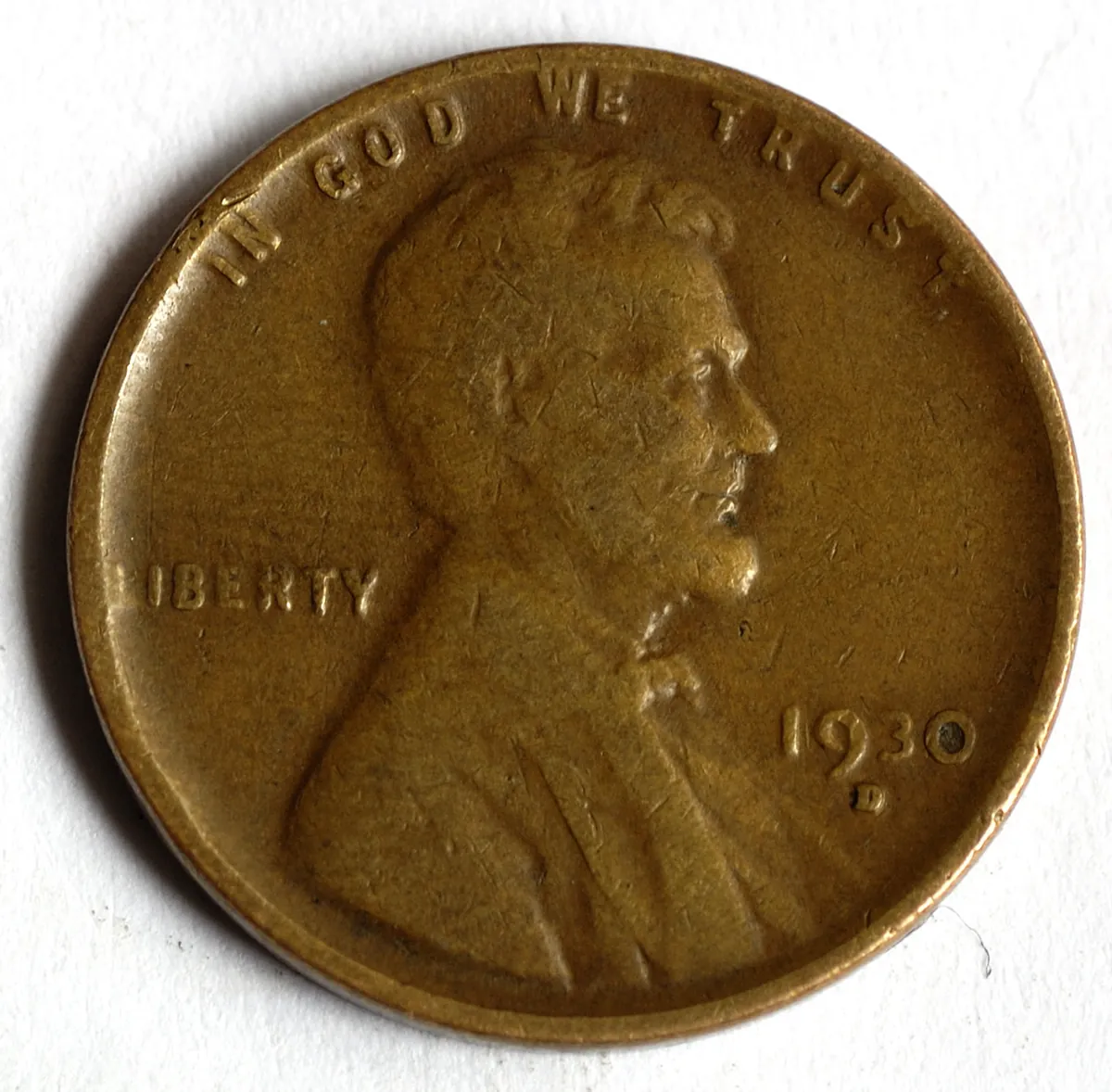
Most modern circulating United States coins stay at face value unless metal or a collector date applies
A circulated 1930-D wheat penny, reused from the wheat penny value guide as a coin price guide example. Date, mint mark, and metal usually matter more than the denomination alone. Photo: Wheat cent 1930 (2).jpg by Doronenko, licensed under CC BY 3.0, via Wikimedia Commons. See also photo credits.
Most modern circulating United States coins stay at face value. The useful split is date and metal. The United States Mint removed silver from circulating dimes and quarters in 1965. Wartime nickels from 1942 through 1945 are a silver exception in a denomination that is otherwise not silver. Wheat cents (1909-1958) are a different series from later Lincoln cents. Indian Head cents, Kennedy halves, Morgan and Peace dollars, and Susan B. Anthony dollars each have their own identification rules, and a 1944 wheat cent is a copper coin unless you are carefully checking a scarce off-metal error. A typical 1943 Lincoln cent is zinc-coated steel, and a 1964 Kennedy half is the 90 percent silver first-year issue. A 1979 dollar coin is usually a clad Susan B. Anthony dollar, not a silver Morgan or Peace dollar. We cite dated melt figures from NGC on the denomination pages, and typical circulated wheat-cent comments from a PCGS article dated 7 September 2023. We do not invent year-by-year charts.
Sold prices and asking prices are not the same. A melt floor is not automatically what a collector will pay for a sharp or scarce coin. If you think you have a key date or a famous error, treat a scan as a first look and consider a professional authenticator, because those coins are widely faked.
These guides are written around United States coins and notes. If you are in the UK, Australia, or Canada, the identification still helps, and a scan can draw on public listings in the markets we search. Face value and melt figures quoted here are from US sources and are in US dollars unless we say otherwise. To sell, a local coin shop is often the practical route for common silver, while collector pieces may belong in a specialist listing. The app can draft a listing for eBay, Facebook Marketplace, or Gumtree.
Start here for a coin: date, mint mark, metal, and whether it is face value, melt, or a collector piece.
Lincoln cents from 1909 to 1958, including common dates, 1943 steel cents, and key dates to check.
Typical 1944 cents are copper. Mint mark and condition matter, and 1944 steel errors are scarce and often faked.
Indian Head cents from 1859 to 1909. Date, mint mark, and condition come before any rarity claim.
1964 90 percent silver, 1965-1970 40 percent silver, and later clad halves, plus varieties to check.
Tell a 90 percent silver quarter from a clad one, and see the dated melt floor for pre-1965 issues.
Face-value Jefferson nickels, wartime silver nickels, and dateless Buffalo nickels.
Silver dimes through 1964, clad Roosevelt dimes, and how to sort them by date and edge.
Morgan and Peace dollars, a dated silver melt floor, and later dollar coins that are often not silver.
A small clad dollar, not a silver Morgan. Most worn examples are about a dollar; check 1979 varieties carefully.
Legal tender at two dollars, plus star notes, red seals, and what a common 1976 note lists for.
Face value is the floor. After 24 June 1968 these notes could no longer be redeemed for silver; any premium depends on series, seal, and condition.
Tell a genuine mint error or doubled-die variety from damage, then compare current listings.
Date, mint mark, and condition, with a dated 90 percent silver melt floor under most worn examples.
Date, mint mark, and condition, with the same dated silver melt floor as a Morgan dollar.
The wartime zinc-coated Lincoln cent, a modest typical range, and why copper 1943 claims need a careful check.
The first-year 90 percent silver issue, with a dated melt floor and notes on proofs and the accented-hair variety.
Usually a first-year Susan B. Anthony dollar: clad, not silver, plus mint marks and the wide-rim variety.
The app scans faster, keeps a history of your items and gives free weekly scans.
One photo is enough to start, and you can add up to two more angles. We identify the item first, you confirm or correct it, then we look up a Worth about figure and a listed range from current public marketplace listings. Those are asking prices, which can sit above what a piece finally sells for. You see the listings themselves when we find enough of them.
Coins and banknotes also draw on Numista. Trading cards use PokéWallet, with a source credit where that data appears. Gold and silver use a live metal price as a floor. If listings are thin, we show a clearly labelled rough estimate rather than inventing a precise number. The app can draft a listing for eBay, Facebook Marketplace, or Gumtree once you are ready to sell. For the short version of this process, read How we price.
They cover circulating United States coins and $2 bills: how to identify what you have, when face value applies, when silver or gold melt is the floor, and when a date or mint mark belongs in a collector market. Each guide cites a source and a date when it quotes a figure.
Yes. Use Scan it online free on this page or on any coin guide, confirm the identification, and we will look up a listed range when we find enough current public listings. Coin figures also draw on Numista.
No. If we do not have a cited, dated figure, we describe the date as scarcer and point you to a current specialist guide, a scan of recent listings, or a professional opinion.
Common silver and gold are often sold to a coin shop or a bullion dealer. Collector dates may do better with a dealer or a public listing. The app can draft a listing for eBay, Facebook Marketplace, or Gumtree. We do not buy coins.
You can also read How we price or start from the homepage.
Updated 11 November 2026. Written by Harris, who built How Much Is It Worth. Figures that we cite include a source and a date. They are not a certified appraisal. See How we price.
The app scans faster, keeps a history of your items and gives free weekly scans.