How much is a silver certificate worth starts with face value. A United States silver certificate is still legal tender, so a $1 note is still worth at least one dollar. After 24 June 1968 those notes could no longer be redeemed for silver. Any collector premium sits on top of that floor, and it depends on the series, the seal, the condition, and whether the note is a star replacement.
The app scans faster, keeps a history of your items and gives free weekly scans.
Example
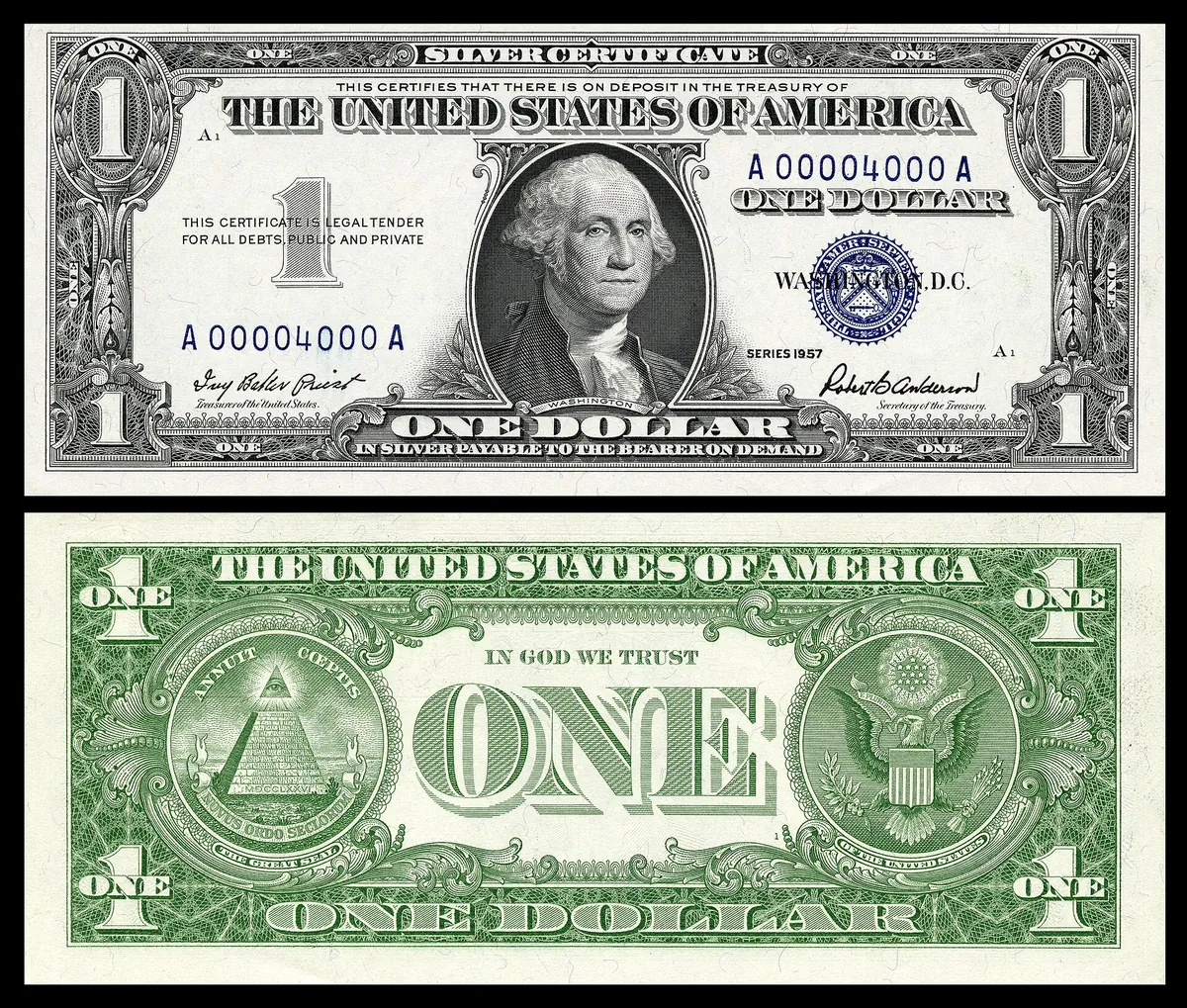
Series 1957 $1 silver certificate, face and back
A common circulated 1957 $1 silver certificate is often only a small premium over face value
A Series 1957 United States $1 silver certificate, both sides. Star notes, earlier series, and high-grade examples can sit well above a common circulated bill. These notes are no longer redeemable for silver; they trade as collectable paper. Photograph from the National Museum of American History. Note design by the Bureau of Engraving and Printing. Public domain. Source: US-$1-SC-1957-Fr.1619.jpg. See also photo credits.

How to identify it
Read the face of the note. A genuine United States silver certificate says "Silver Certificate" and names the denomination. Later small-size $1 notes are the ones people usually find in a drawer or a souvenir envelope. They often have a blue Treasury seal. Older large-size notes, higher denominations, and unusual experimental or star issues are a different market from a worn mid-century $1.
Photograph the face and the back, close enough to read the series year, the seal colour, the serial number, and the signatures. A star at the end of the serial marks a replacement note. Do not wash, iron, tape, or press a folded bill to make the photo look cleaner. That can lower collector interest, and it can do damage you cannot reverse. Not sure which series you have? Snap a photo of both sides and the app reads the note so you can confirm it.
What changes the price
Face value is the floor, not a rumour that expires. If a shop will not accept the note as money, that is a shop policy, not a change in the note's legal status. The New York Fed's Liberty Street Economics desk, writing in January 2015, put the same point simply: outstanding silver certificates remain legal tender and can be spent like other US currency.
Collector interest is a separate question. Series, seal colour, denomination, and condition all change the listings you should compare. Star notes and unusual serials can attract a premium that a random circulated $1 will not. High grade and scarce earlier types sit in a wider market than a folded later $1. We will not invent a year-by-year chart here. Match current public listings to the exact type you actually have.
Melt versus collectible value
There is no current silver "melt" figure for these notes. The Treasury published procedures for exchanging silver certificates for silver bullion during a closing period that ended on 24 June 1968. After that date, the same Treasury notice said, the certificates would continue to be usable as legal currency, but could not be redeemed for silver. Public Law 90-29, approved 24 June 1967, had set that one-year exchange window. A silver certificate is paper money, not a silver coin, so do not price it off a spot silver ticker.
If you also have silver coins from the same drawer, those are a different question. Start at how much is my silver worth or the coin guides. For another US note that is still legal tender, see how much is a 2 dollar bill worth.
Listed versus sold
An asking price on a listing is not a sold price. A dealer may pay close to face for a worn later $1, and a retail "catalogue" figure can sit above what a similar note actually brought. Banknote figures in the app draw on Numista as well as current public listings. When listings are thin, we label a rough estimate rather than inventing a precise number. See How we price.
Where to sell
People sell silver certificates to paper-money dealers, at coin shows, and on eBay. A worn common note may be easier to spend at face value than to list. The app can draft a listing for eBay, Facebook Marketplace, or Gumtree. Outside the United States these notes are collectibles rather than everyday spending money, and any figures you compare should be checked in the currency of the listing.
Scan and list
- Photograph the face and the back, including the series year, seal, and full serial number.
- Confirm the denomination, whether it is a star note, and any tears, stains, or writing.
- Review the Worth about figure and the listed range when we find enough current public listings.
You can start with a free web scan in the box on this page. A scan is a first look at the type and at current listings, not a formal grading opinion. If the note looks like an early large-size issue or a dramatic serial, treat the estimate as a starting point and compare several recent listings, or ask a paper-money dealer, before you sell or insure it.
The app scans faster, keeps a history of your items and gives free weekly scans.
What makes How Much Is It Worth different
One photo is enough to start, and you can add up to two more angles. We identify the item first, you confirm or correct it, then we look up a Worth about figure and a listed range from current public marketplace listings. Those are asking prices, which can sit above what a piece finally sells for. You see the listings themselves when we find enough of them.
Coins and banknotes also draw on Numista. Trading cards use PokéWallet, with a source credit where that data appears. Gold and silver use a live metal price as a floor. If listings are thin, we show a clearly labelled rough estimate rather than inventing a precise number. The app can draft a listing for eBay, Facebook Marketplace, or Gumtree once you are ready to sell. For the short version of this process, read How we price.
FAQ
How much is a silver certificate worth?
A United States silver certificate is still legal tender, so it is worth at least its face value. After 24 June 1968 it could no longer be redeemed for silver. Any collector premium depends on the series, seal, condition, and whether it is a star note. Compare current public listings for the exact type, or scan it on this page.
Can I still cash a silver certificate in for silver?
No. A Treasury notice formalising the closing exchange procedures said the period of exchangeability ended on 24 June 1968, and that after that date the certificates would remain usable as legal currency but could not be redeemed for silver. Public Law 90-29 had set that one-year window the year before.
Does seal colour or a star serial change the value?
Yes, they change which listings you should compare. Later small-size $1 notes often have a blue Treasury seal. A star at the end of the serial marks a replacement note, which collectors often treat separately. Neither detail has one automatic price. Identify the series and condition first.
Can I scan a silver certificate with the app?
Yes. Photograph the face and the back, including the series year, seal, and full serial number, then confirm the type. Banknote figures in the app draw on Numista as well as current public listings. See How we price.
Related guides
Sources
- United States Mint, historical Treasury notice “Procedures for Exchanging Silver,” US Mint, accessed 11 November 2026. The period of exchangeability ended 24 June 1968; after that date silver certificates would remain usable as legal currency but could not be redeemed for silver.
- Public Law 90-29, approved 24 June 1967, 81 Stat. 77. Section 2 made silver certificates exchangeable for silver bullion for one year after enactment, and provided that thereafter they would no longer be redeemable in silver.
- Federal Reserve Bank of New York, Liberty Street Economics, “Historical Echoes: The Demise of Silver Certificates,” Liberty Street Economics, January 2015. Outstanding silver certificates remain legal tender and can be spent like other US currency.
Updated 11 November 2026. Written by Harris, who built How Much Is It Worth. Figures that we cite include a source and a date. They are not a certified appraisal. See How we price.
The app scans faster, keeps a history of your items and gives free weekly scans.
See all guides on the homepage, or read how we price.