A card value scanner identifies a trading card from a photo and tells you what that exact card is selling for. It reads the set, card number and print, lets you set the condition, then shows a price range from current listings. How Much Is It Worth: Scanner does this for Pokémon, sports cards, Yu-Gi-Oh and Magic in the iPhone app, and you can try one card online free on this page.
Best on iPhone
Start your free 3-day trial. 3 free scans + 3-day unlimited trial in How Much Is It Worth: Scanner. Got a whole box to get through? The trial gives you unlimited scans, and after your free scans you still get 1 free scan every week.
The 3-day free trial comes with the Yearly plan, and the app shows every plan before you start. Cancel in your App Store settings at least 24 hours before the trial ends and you won't be charged.
Not on iPhone yet? Try one free web scan right here, no download needed. On Android? Check https://howmuchisitworth.today/ for the Android release.
No download needed: snap or upload a photo below for one free web scan a day. The app gives you 3 free scans, then 1 free every week, saves your history and drafts listings for you.
Real scan · prices checked 10 Nov 2026
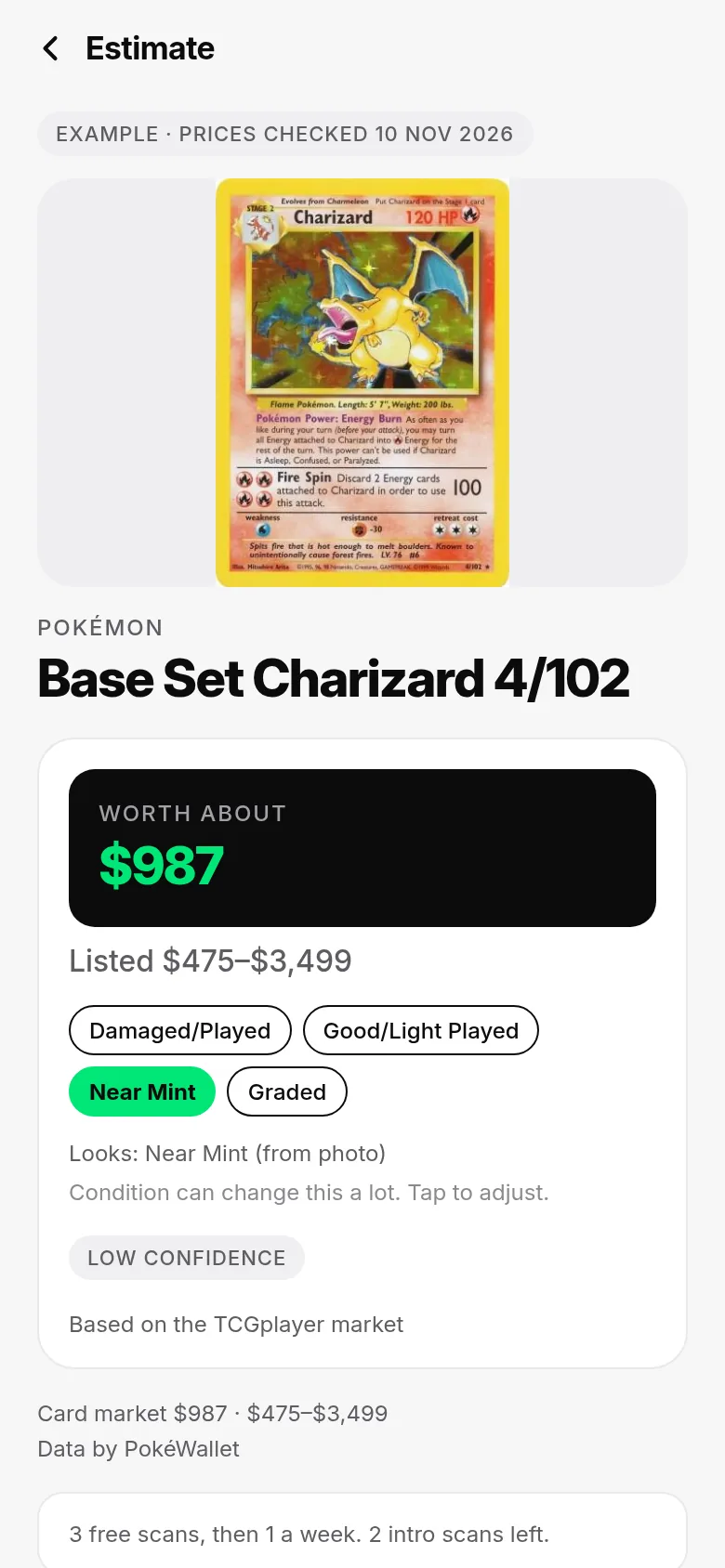
Base Set Charizard 4/102, unlimited, raw
Worth about $987 · listed $475 to $3,499 · Near Mint from photo · low confidence
Our own card result. The condition chips change the figure, and the wide listed range is why confidence shows as low. In-app example from How Much Is It Worth. Screenshot is our own work. The card image inside it comes from the PokéWallet Images API and the artwork belongs to its rights holders. See also photo credits.
Why two cards with the same name can be worth wildly different amounts
Anyone who's sorted a binder knows this. The same player or Pokémon can show up on a dozen different cards, and only one or two of them are the money card. What decides it:
- Set and year. A 1999 Base Set print and a 2016 Evolutions reprint of the same art are different markets entirely.
- Card number and parallel. Sports cards especially: the base card, the refractor, the numbered parallel and the autograph all share a name and nothing else.
- Edition and print run. 1st Edition stamps, shadowless prints, rookie cards, short prints.
- Language. English, Japanese and other languages trade separately.
- Raw or graded. A card in a PSA, BGS, CGC or SGC slab is priced by its grade. A raw card is priced on what a buyer thinks it'd grade, which is always a discount for the risk.
- Condition. Centering, corners, edges and surface. One soft corner can halve a raw card's price.
A card scanner online earns its keep by getting those details right before it shows you a number. Otherwise you're just looking at an average of the wrong cards.
How our card scanner works
- Snap the front, then the back. For slabs, make sure the label is readable.
- Confirm the card. We show the set, number and variant we think it is. Fix it if we've picked the wrong parallel or year.
- Pick the condition. Damaged or Played, Good or Light Played, Near Mint, or Graded. The price updates as you tap.
- Read the range. A Worth about figure, the listed range and the listings. For supported card games the card market figure comes from PokéWallet, credited on screen.
The app keeps every card you scan in a collection with a running total, so you can price a whole binder and see what the lot is worth. The web scan on this page does one card a day.
A real scan: Base Set Charizard 4/102
We scanned an unlimited, raw Base Set Charizard 4/102 on 10 November 2026. The app called it Near Mint from the photo and came back with Worth about $987, a listed range of $475 to $3,499, and low confidence. Why low? Because that range is enormous. It mixes played copies, near mint copies and sellers dreaming. That's exactly the case where you need to set the condition honestly and look at the listings themselves rather than grab the top number. Card market figure via PokéWallet.
Raw vs graded: what changes
| Raw card | Graded (slabbed) card | |
|---|---|---|
| What sets the price | The buyer's guess at its condition | The number on the label and the grading company |
| What to photograph | Front, back, close-ups of any corner or edge wear | The label (cert number, grade) and the card through the slab |
| Typical risk | Hidden creases, trimmed edges, fakes | Fake slabs and swapped labels on big cards |
| Who buys | Players, collectors, flippers who submit for grading | Collectors who want certainty, investors |
Should you grade? Only if the card's value at a high grade clears the grading fee, the shipping and the wait by a decent margin, and you're confident about centering and surface. Scan it raw first, then compare the listings for that same card in graded slabs. If the gap's small, sell it raw.
Card types we price
- Pokémon card scanner, for set symbols, 1st Edition stamps and Japanese cards.
- Sports cards, with deeper guides for baseball, football and basketball.
- Yu-Gi-Oh cards, where the set code and rarity are everything.
- Magic: The Gathering, where printing and foil matter more than the card name.
- Everything else starts at how much is my trading card worth.
Photo tips from people who scan a lot of cards
- Lay the card on something dark and flat. A black mousepad is perfect.
- Tilt the phone slightly to kill glare on holos and foils. Don't use the flash.
- Take it out of a scratched top loader if you can do it safely. Leave slabs closed.
- Shoot the back. It shows edge wear and helps spot fakes, since the back print on counterfeits is often off in colour or sharpness.
Spotting fakes before you price
If a card is famous, it's faked. Be wary of glossy surfaces on cards that should be matte, wrong fonts, blurry energy symbols, missing texture on modern textured cards and backs that look too blue or too purple. A scan helps you find the real listings to compare against, but it isn't an authentication service. For a high-value card, get it checked by a grading company before you sell.
Selling once you know the price
For cheaper cards, bundles and lots move faster than singles. For anything over a few dollars, list it as a single with clear photos of front, back and corners. The app drafts the listing for eBay, Facebook Marketplace or Gumtree from your scan, so you're not typing out set numbers by hand.
3 free scans + 3-day unlimited trial
What makes How Much Is It Worth different
One photo is enough to start, and you can add up to two more angles. We identify the item first, you confirm or correct it, then we look up a Worth about figure and a listed range from current public marketplace listings. Those are asking prices, which can sit above what a piece finally sells for. You see the listings themselves when we find enough of them.
Coins and banknotes also draw on Numista. Trading cards use PokéWallet, with a source credit where that data appears. Gold and silver use a live metal price as a floor. If listings are thin, we show a clearly labelled rough estimate rather than inventing a precise number. The app can draft a listing for eBay, Facebook Marketplace, or Gumtree once you are ready to sell. For the short version of this process, read How we price.
Start your free 3-day trial
3 free scans + 3-day unlimited trial
| Option | What you get |
|---|---|
| Free in the app | 3 free scans to start, then 1 free scan every week |
| 3-day free trial | Unlimited scans, every listing behind the price, listing drafts and collections |
| Web scan on this site | One free scan a day per connection, no download |
The app shows every plan before your trial starts. There are no one-time credit packs. On Android? Check https://howmuchisitworth.today/ for the Android release.
FAQ
Is there a free card value scanner?
Yes. The How Much Is It Worth app gives you 3 free scans and then 1 a week, and you can scan one card a day free on this page in your browser. Premium gives unlimited scans, with a 3-day free trial on the Yearly plan, which is handy for a full binder.
Can I scan cards online without an app?
Yes. The web scan on this page works in any browser, once a day. Upload the front and back, confirm the card, and you'll see a range from current listings.
Which cards can it price?
Pokémon, sports cards (baseball, football, basketball and more), Yu-Gi-Oh and Magic: The Gathering, plus most other trading cards that have public listings. Supported card games also use PokéWallet card market data.
How does it tell a base card from a parallel?
From the photo: card number, set logo, finish and any serial numbering. Parallels can look alike, so we show you what we think it is and you confirm or correct it before we price.
Can I scan a graded card in a slab?
Yes. Photograph it so the label, grade and certificate number are readable. Choose Graded as the condition, and compare against listings at that grade.
Is my card worth grading?
Scan it raw, then look at what the same card sells for at high grades. If the graded price doesn't comfortably cover fees, postage and the wait, sell it raw. Centering, corners, edges and surface decide the grade.
Why is the price range so wide on some cards?
Because listings mix condition, raw and graded copies, and hopeful sellers. A wide range comes with a lower confidence level. Set the condition honestly and look at the listings to see where your card really sits.
Can the scanner tell if my card is fake?
No scanner can authenticate a card from a photo. It can show you genuine listings to compare against. For a valuable card, get it authenticated by a grading company.
Does it work for Japanese or other language cards?
Yes. Language is part of the identification, and Japanese and English versions are priced separately.
Can I price a whole collection?
Yes. In the app, every scan saves to a collection with a running estimated total, so you can see what a binder or box is worth.
Can I scan cards on an Android phone?
On Android? Check https://howmuchisitworth.today/ for the Android release. For now, use the web scan on this page in your phone browser; it handles one card a day.
Does the scanner grade my card?
No. It reads condition from the photo as a starting point and lets you change it. An official grade only comes from a grading company such as PSA, CGC or BGS.
Related card guides
Sources
- PokéWallet card market figure (TCGplayer market) and public listing range for an unlimited Base Set Charizard 4/102 holofoil, raw, checked 10 November 2026 (Australia/Melbourne): Worth about $987, listed $475 to $3,499, low confidence. Data by PokéWallet.
- How the app prices items is described on How we price.
Pokémon and Pokémon character names are trademarks of Nintendo, Creatures Inc., Game Freak, and The Pokémon Company. This site and the How Much Is It Worth app are not affiliated with, endorsed by, or sponsored by those parties, or by Wizards of the Coast. Card artwork remains the property of its owners.
Updated 16 November 2026. Written by Harris, who built How Much Is It Worth and tests every scan type on real items. Figures that we cite include a source and a date. They are not a certified appraisal. See How we price.
3 free scans + 3-day unlimited trial
See all guides on the homepage, or read how we price.